AMD's comeback in numbers: from a $1.62 stock to taking on Nvidia
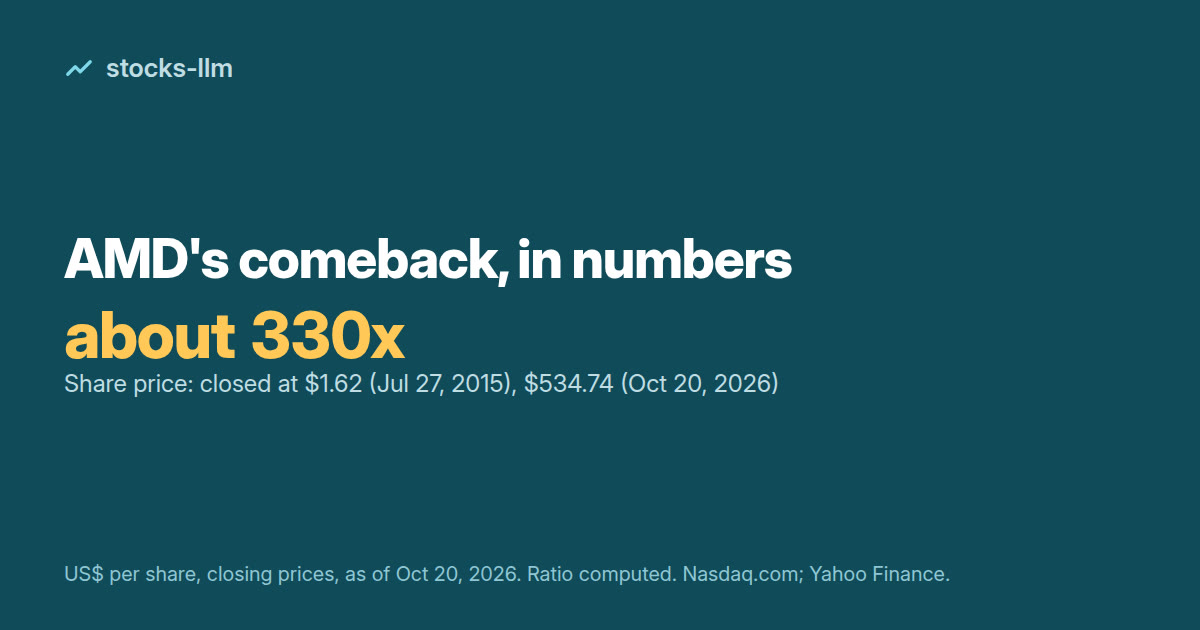
By its share price, AMD has come a long way: the stock closed at $1.62 on July 27, 2015, and at $534.74 on October 20, 2026, about 330 times higher (computed, price only). In AI chips it is still far behind Nvidia, whose data center sales were about 12 times AMD's in their latest fiscal years.
AMD designs processors for PCs and servers, along with graphics chips that are now also sold for AI work. Its 2015 annual report showed a company under strain. Revenue fell 28% to $4.0 billion, from $5.5 billion in 2014, and the net loss was $660 million. At December 26, 2015, AMD held $785 million in cash against about $2.0 billion of long-term debt, and stockholders' equity was negative $412 million, as reported in 2016.
That July the stock closed at $1.62, its lowest close from October 2014 to October 2026. Multiplied by the shares outstanding on the nearest quarterly filing, that put the whole company's market value at about $1.3 billion (computed). The figure is a closing price, not an intraday low, and the chart below uses month-end closes with the exact daily closes marked.
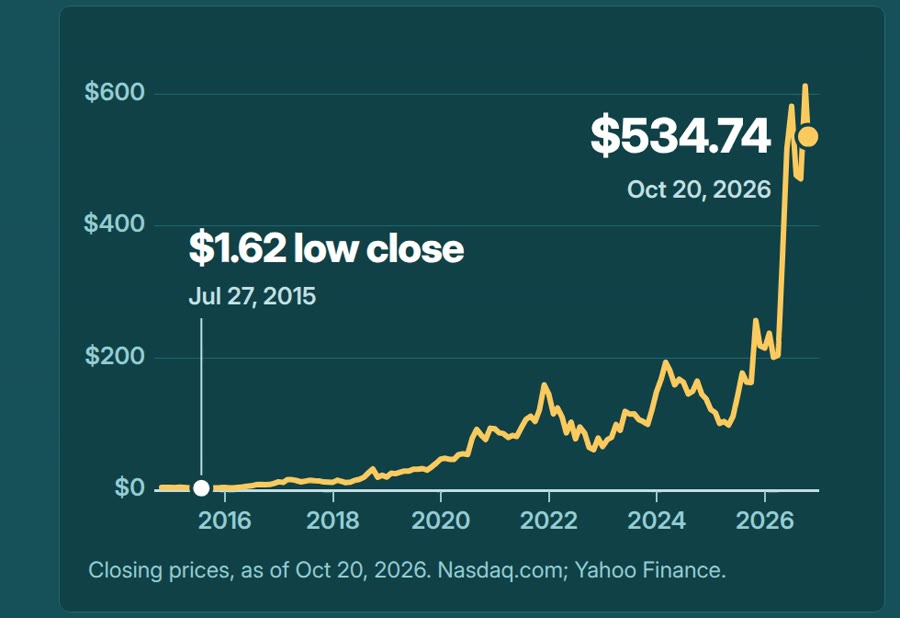
Lisa Su became chief executive in October 2014. In 2017 AMD's new Zen chips went on sale: Ryzen processors for PCs in March and EPYC processors for servers in June. These are dates on the timeline, not measured causes: on the day Ryzen 7 went on sale the stock already closed at $13.90.
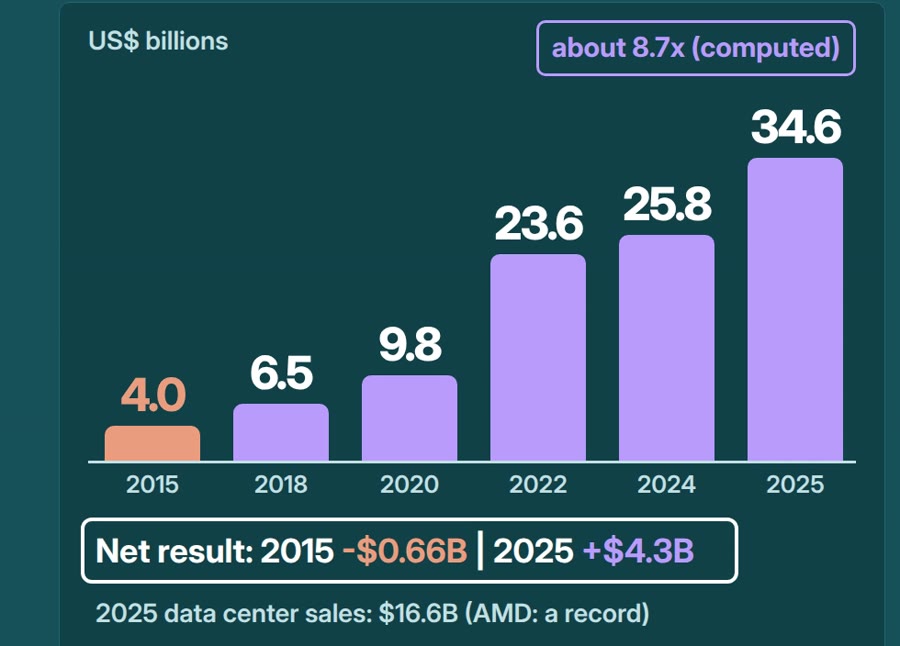
Sales are the second measure. From the annual 10-K filings, AMD's revenue was $4.0 billion in 2015, $6.5 billion in 2018, $9.8 billion in 2020, $23.6 billion in 2022, $25.8 billion in 2024 and $34.6 billion in 2025, about 8.7 times the 2015 level (computed). Figures from 2022 onward include Xilinx, which AMD acquired in February 2022, so the series is not like for like across that year. The $660 million loss of 2015 became net income of $4.3 billion in 2025, and data center sales reached $16.6 billion, which AMD called a record.
The one stock move tied to a specific event came on October 6, 2025. AMD and OpenAI announced a deal to deploy six gigawatts of AMD GPUs, and AMD issued OpenAI a warrant for up to 160 million AMD shares, vesting with deployments and share price targets. The stock closed at $203.71 that day, up 23.7% from $164.67 on October 3, in one trading day.
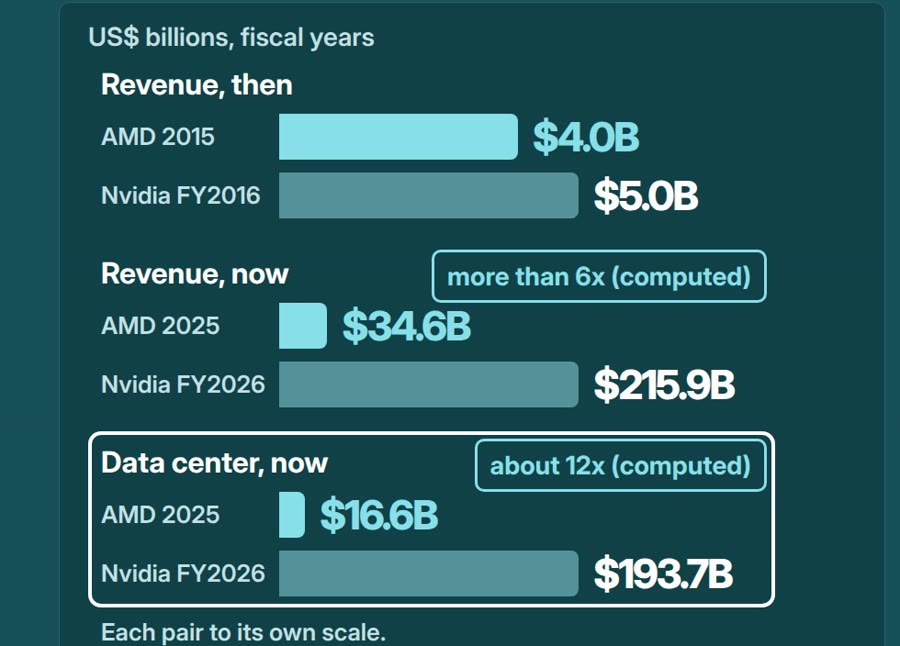
The common misreading is that taking on Nvidia means catching it. The checked figures, compared by fiscal year, say otherwise. In 2015 the two were close in revenue, AMD at $4.0 billion against $5.0 billion for Nvidia's fiscal 2016. Now AMD's $34.6 billion for 2025 compares with $215.9 billion for Nvidia's fiscal 2026, more than six times as much. In data center sales the gap is about 12 times, $193.7 billion against $16.6 billion (computed). Nvidia's fiscal years end in late January.
As of October 20, 2026, AMD closed at $534.74, which puts its market value at about $873 billion (computed from the latest quarterly share count). All figures are nominal US dollars, and prices change with every trading day.
The 330 times multiple is a price ratio measured from a single low close, so its size depends on that starting point. Revenue and the comparison with Nvidia measure something different: AMD grew about 8.7 times, yet Nvidia's sales grew faster, so the dollar gap between them widened while AMD itself expanded.
Watch the short video: YouTube