Kodak built the first digital camera: what Kodak is worth today
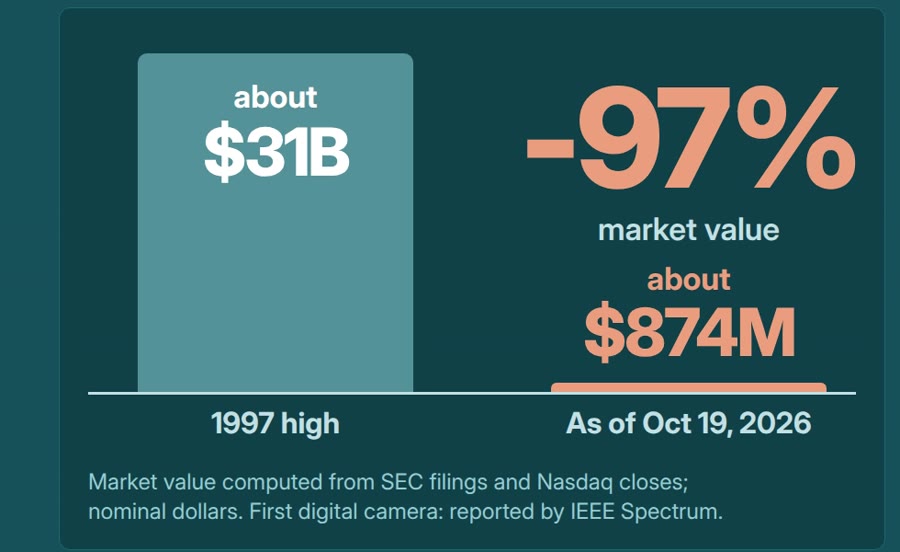
Kodak, the company whose engineer built the first digital camera, had a market value of about $874 million as of October 19, 2026. That is down about 97% from about $31 billion at its 1997 high, both values computed in nominal dollars.
The camera came first. IEEE Spectrum reports that Kodak engineer Steven Sasson took the first photo with the first digital camera in December 1975. The prototype made images of 100 by 100 pixels, took 50 milliseconds to capture each one and 23 seconds to save it to tape. Kodak filed a patent on the electronic still camera on May 20, 1977, and US Patent 4,131,919 was granted to Eastman Kodak on December 26, 1978.
For the next two decades, film paid the bills. Kodak reported sales of $14.98 billion in 1995, $15.97 billion in 1996 and $14.54 billion in 1997, and it had about 94,800 employees at the end of 1996. Its 1997 10-K says worldwide film sales held level that year on 7% higher volume.
The two market values come from the same simple calculation: share price times shares outstanding. The 1997 figure uses the first-quarter 1997 stock high from Kodak's 1997 10-K and the 331.8 million shares outstanding at the end of 1996. Today's figure uses the KODK closing price on Nasdaq on October 19, 2026 and the 97.9 million shares Kodak reported on July 29, 2026. Neither is adjusted for inflation.
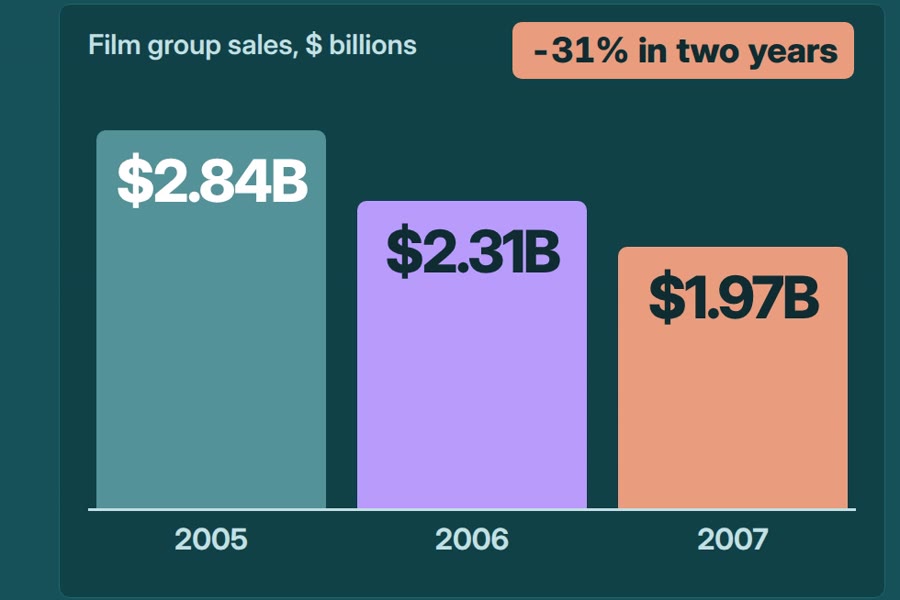
A common version of the story says Kodak stayed with film while the world moved on. Kodak's own filings tell a different story. Its 2007 10-K says that in 2006, for the first time in its history, more than half of Kodak's revenue came from digital products. The pressure came from film itself: sales of the Film Products Group fell from $2.84 billion in 2005 to $2.31 billion in 2006 and $1.97 billion in 2007, a computed drop of about 31% in two years. Kodak's 10-K put it plainly: digital substitution has led to substantial declines in film usage.
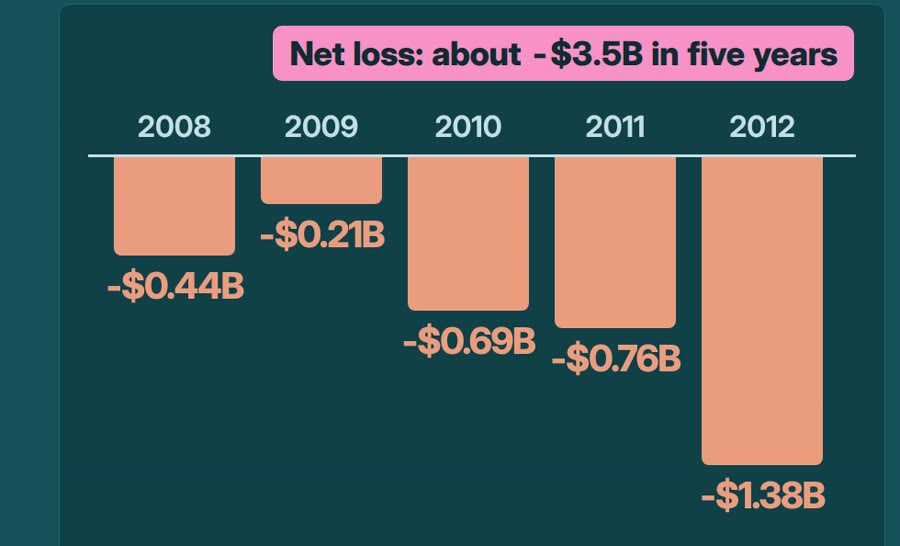
The losses followed. As reported in the 2012 10-K, Kodak's net loss was $0.44 billion in 2008, $0.21 billion in 2009, $0.69 billion in 2010, $0.76 billion in 2011 and $1.38 billion in 2012, about $3.5 billion in five years. On January 19, 2012, Kodak and its US subsidiaries filed for chapter 11 bankruptcy protection, a court-supervised reorganization rather than a shutdown. Weeks later, on February 9, 2012, it announced it would stop making its own digital cameras.
Kodak emerged from chapter 11 on September 3, 2013, and all of its previously issued shares were cancelled. That detail matters for anyone comparing prices across eras. The KODK shares that trade today are a new stock, so an old share price and a new share price do not measure the same thing. Market value, the whole company at each date, is the comparison that holds up.
Kodak still operates, at a much smaller size. Its 2025 10-K describes a global manufacturer focused on commercial print and advanced materials and chemicals. It reported $1.07 billion in 2025 revenue, 67% of it from print, and about 3,500 employees, against about 26,900 in 2007 and about 17,100 in 2011. It still makes film for still photography and for motion pictures.
Building a new technology early and earning a living from it are separate problems. When the product that carries a company's sales shrinks faster than the new one can replace it, revenue, profits and market value can all fall at once, even after the shift has started.
Watch the short video: YouTube
Sources
- IEEE Spectrum, first digital camera history, April 2022
- US Patent 4,131,919, Electronic still camera
- Eastman Kodak 10-K for 1996
- Eastman Kodak 10-K for 1997
- Eastman Kodak 10-K for 2007
- Eastman Kodak 10-K for 2011
- Eastman Kodak 8-K, chapter 11 filing, January 19, 2012
- Eastman Kodak SEC XBRL financial data, net losses 2008 to 2012
- Eastman Kodak 8-K, emergence from chapter 11, September 3, 2013
- Eastman Kodak 10-K for 2025
- Nasdaq.com, KODK historical prices