How Much of Each Sales Dollar Do Companies Keep? Nvidia 56c, Costco 3c
In their latest annual reports, Nvidia kept about 56 cents of net profit out of every dollar of sales, while Walmart and Costco kept about 3 cents each. The gap looks enormous, but Costco closes much of it with speed: it rang up about $3.40 of sales for every dollar of assets on its books.

Net profit margin answers a plain question: after paying for everything a business costs to run, including taxes and interest, how much of each sales dollar is left for the company's own shareholders? Here it is computed as net income attributable to the company divided by total revenue, taken from each company's latest annual 10-K filing with the SEC. Those fiscal years end between December 31, 2025 and September 30, 2026, so each company is measured on its latest full year rather than on one shared calendar year. The starting point was a question put to the stocks-llm app, which screens more than 300 S&P 500 companies, and every figure it returned was then re-checked in the SEC filings.
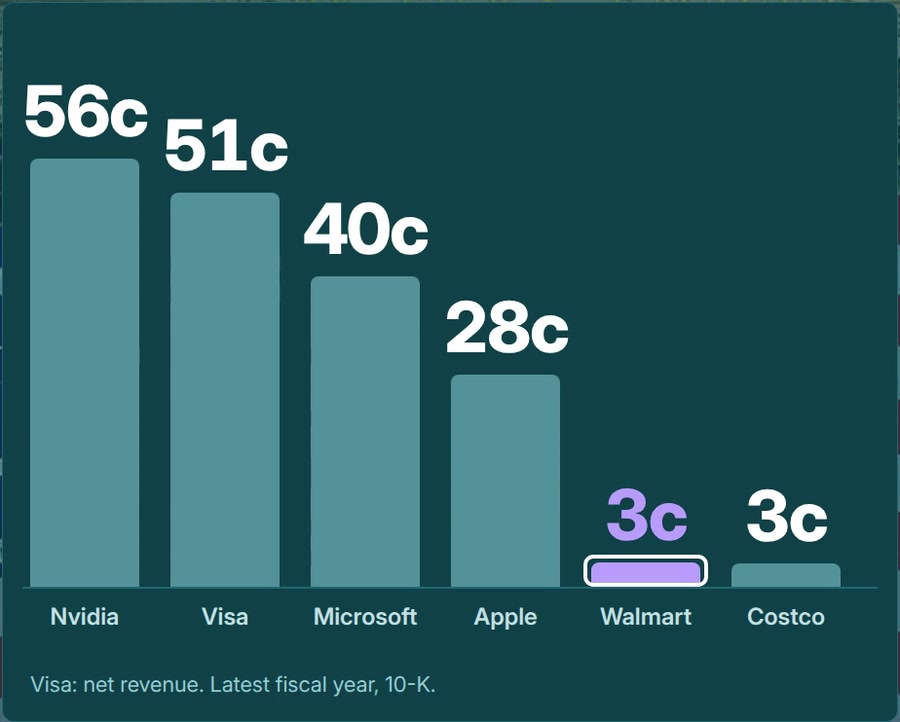
Among the famous names, Nvidia kept about 56 cents per dollar of sales in its fiscal year ended January 25, 2026. Visa kept about 51 cents, measured on its net revenue. Microsoft kept about 40 cents and Apple about 28. Walmart and Costco kept about 3 cents each, 3.1 and 3.0 cents to one decimal. Some household names keep even less: McKesson, the drug distributor, kept about 1.2 cents, and Kroger about 0.7 cents in a year that carried $2.7 billion of restructuring and impairment charges.
A high margin is not always what it seems. At the top of the stocks-llm screen sat memory and storage makers, landlords and an exchange. Western Digital and Simon Property Group each kept about 73 cents per dollar, but both were lifted by one-off paper gains: Western Digital's net income includes a $6.5 billion unrealized gain on equity securities, and Simon's includes a non-cash gain of $2.89 billion, reported by the company, mainly from remeasuring its existing stake when it acquired the rest of Taubman Realty Group. Vici Properties, a casino landlord, kept about 69 cents, followed by Micron at 64, CME Group at 62 and AppLovin at 61. The app's own figures for two companies included profit that belongs to noncontrolling interests, so this comparison uses only profit attributable to each company's shareholders. The list is a screen, not a certified ranking.
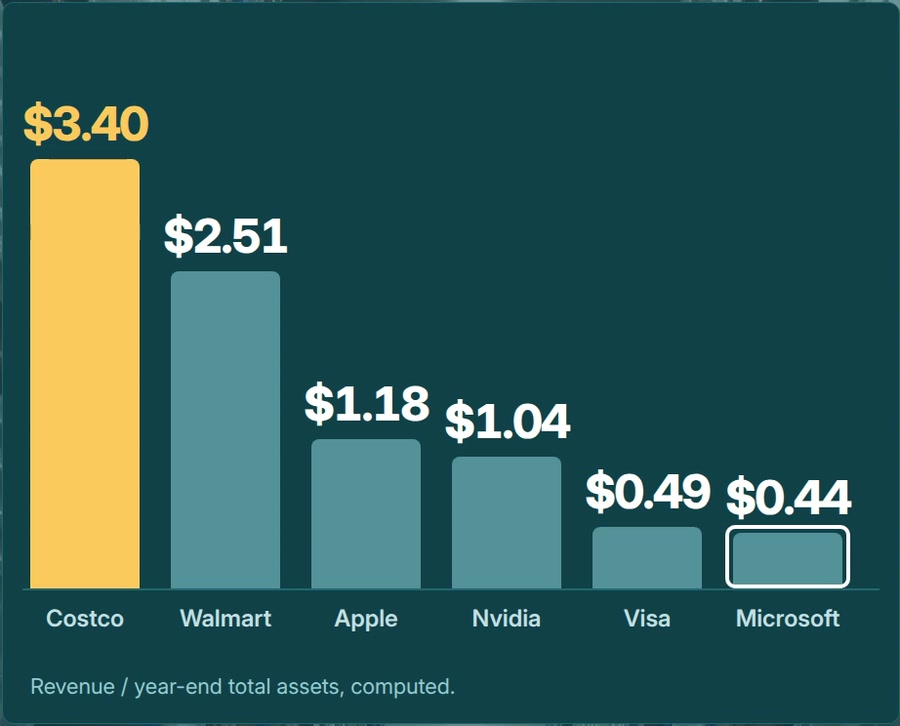
The opposite misreading is that a 3 cent margin means a small business. Margin says how much profit each sale leaves; it says nothing about how many sales each dollar of assets produces. Dividing revenue by year-end total assets, Costco rang up about $3.40 of sales per dollar of assets, Walmart $2.51, Apple $1.18 and Nvidia $1.04. Visa came in at $0.49 and Microsoft at about $0.44. These are computed figures from the same 10-K filings.
Put the two measures together and the gap narrows sharply. On the latest fiscal year figures, Costco earned about 10.4 cents of net profit a year for every dollar of assets, and Microsoft about 17.6 cents. On sales, Microsoft's margin is about 13 times Costco's; on assets, the gap is about 1.7 times, under two. Microsoft still earns more per dollar of assets, but the distance is far smaller than the margins alone suggest. All of these figures rest on filings checked on November 18, 2026, and they change as each company files its next annual report.
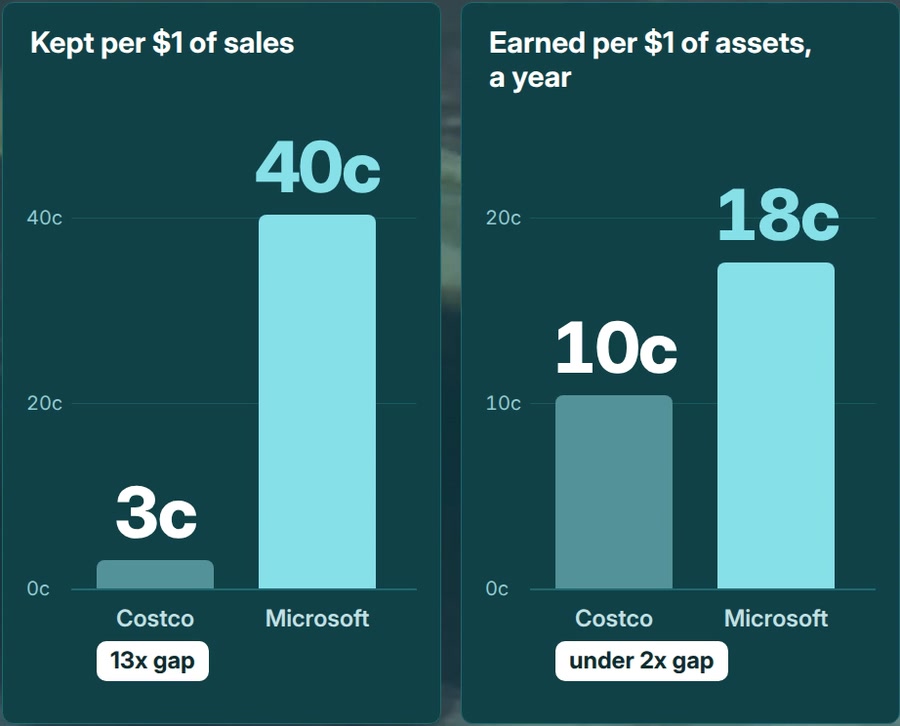
Profit on assets is roughly margin multiplied by how fast assets turn into sales, so a business that keeps 3 cents but sells its way through its assets more than three times a year can earn on its assets far closer to a 40 cent business than its margin suggests.
Watch the short video: YouTube