Oversold on RSI and Bought by a House Member: Nvidia and Datadog
Two big stocks that pass both tests, confirmed at the House filings, are Nvidia, with a 14-day RSI of 21.1, and Datadog, at 27.9, both in stocks-llm's answer as of the November 18, 2026 close. Each also appears in a House member's filing with a disclosed purchase from late September or early October 2026.
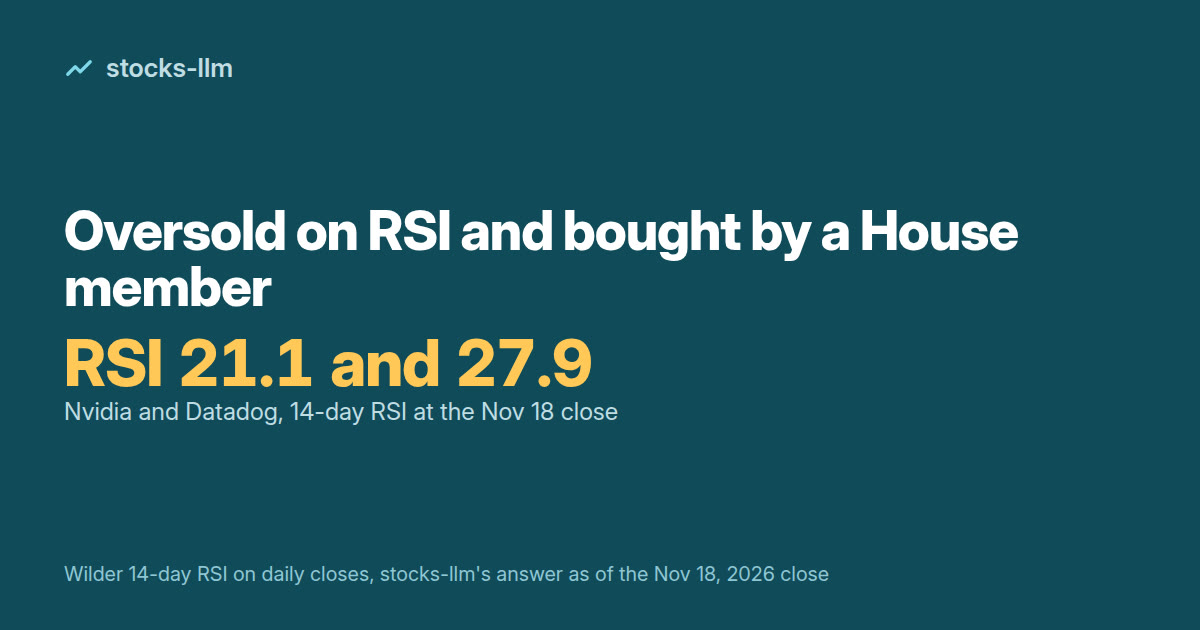
The question joins two kinds of data that usually sit in separate places. Congressional trade disclosures come from the STOCK Act, while RSI, the relative strength index, comes from chart analysis. People who track House filings tend to look at the filings, and people who use RSI tend to look at the chart. Placing both on one list shows which names meet the two conditions at the same time.
stocks-llm's answer of November 19, 2026 joined them in one plain-English question. It asked for stocks worth more than ten billion dollars, a 14-day RSI under 30 on daily closes, and at least one disclosed House purchase in the trailing 90 days or so. This list covers the House only: Senate trades are not included. The answer named other companies too; we only show the ones we confirmed at the House filings.
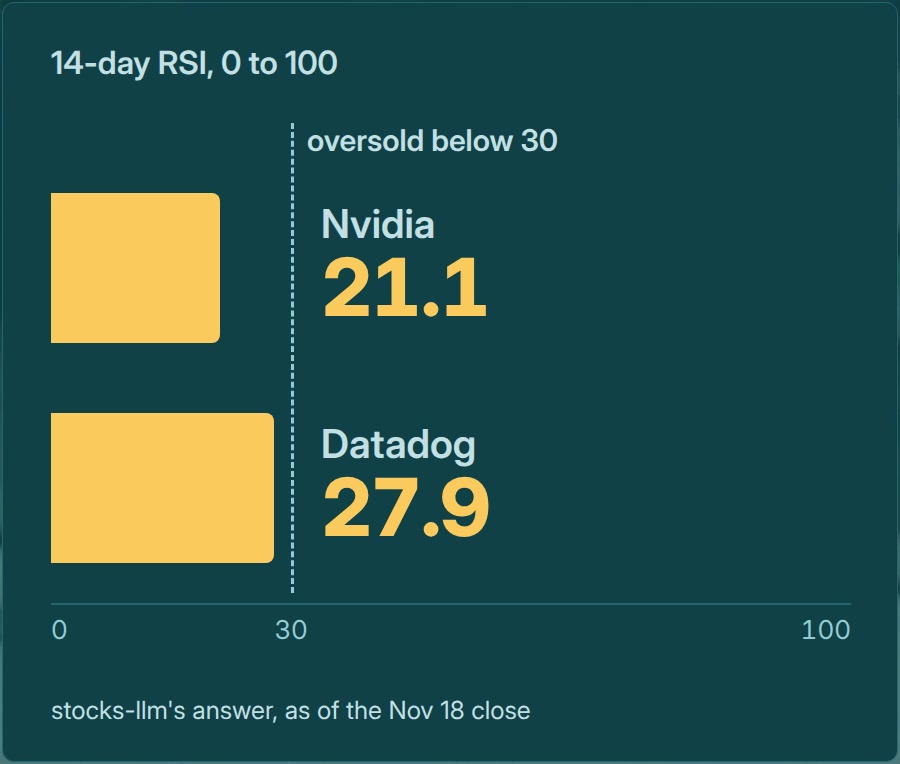
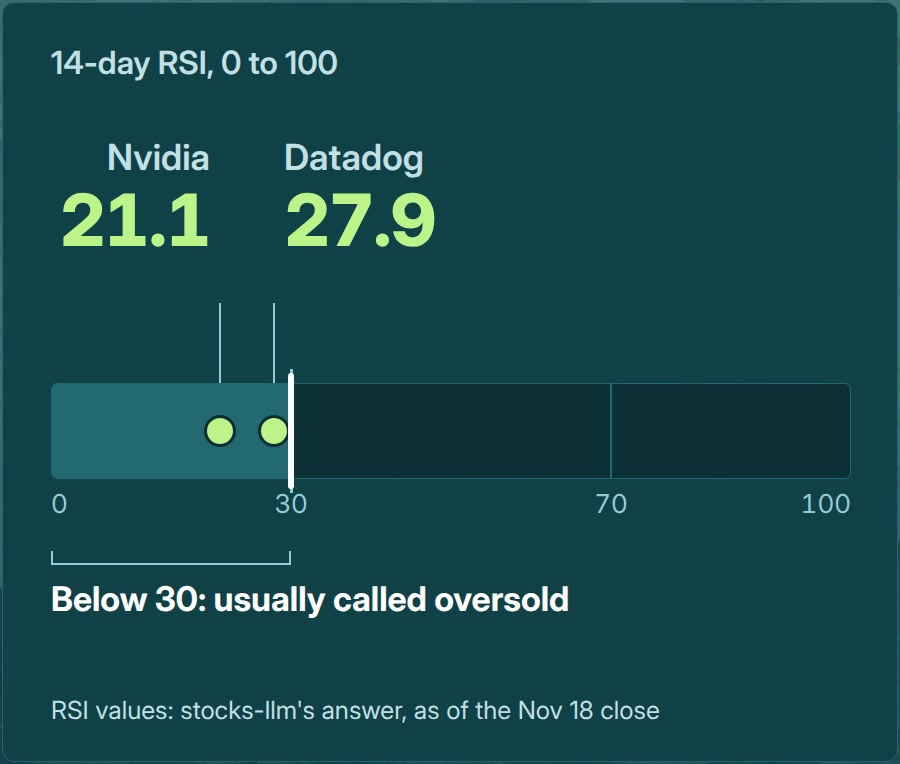
RSI is a gauge from 0 to 100 that compares the size of recent gains with recent losses. This version uses Wilder's 14-day method on daily closing prices, which smooths those gains and losses over 14 sessions. Readings below 30 are usually called oversold, a convention rather than a verdict. In stocks-llm's answer, as of the November 18 close, Nvidia read 21.1 and Datadog 27.9, and a recomputation from Nasdaq.com daily closes gave the same values. Other RSI formulas produce different readings, so the method matters whenever two readings are compared.
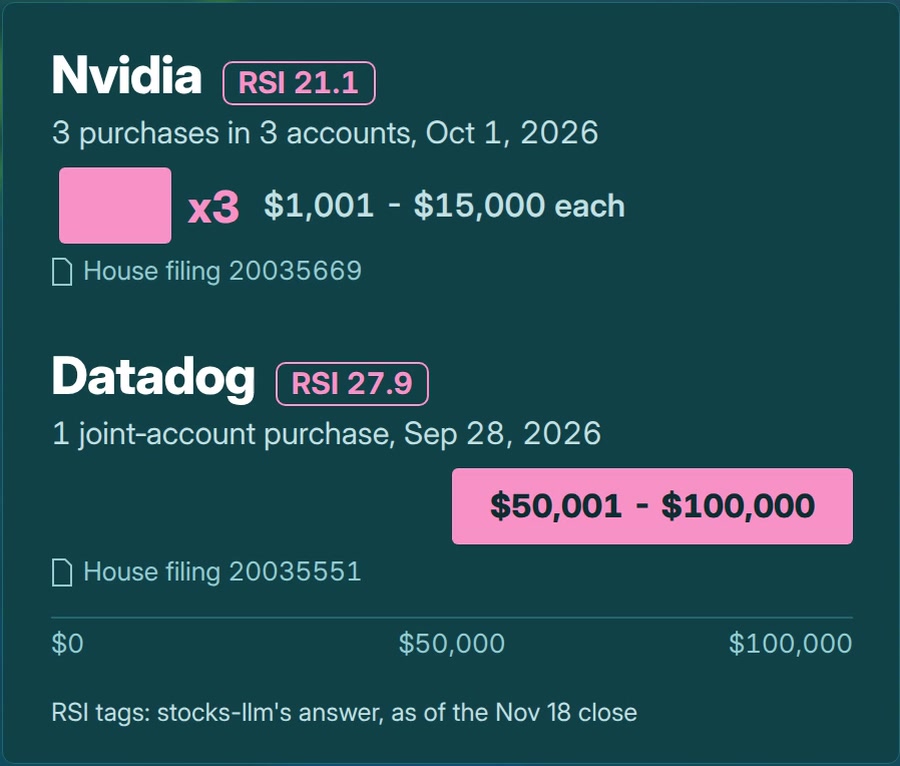
The House side rests on two filings at the House Clerk. Filing 20035669 lists three Nvidia purchases on October 1, 2026, in three accounts, each in the band of $1,001 to $15,000. Filing 20035551 lists a joint-account purchase of Datadog Class A shares on September 28, 2026, in the band of $50,001 to $100,000. Amounts are ranges, not exact sums, so the three Nvidia bands are not added into a single figure. The filings were signed on October 22 and October 19, 21 days after each trade.
A common misreading treats each half of the join as a signal. The answer's own caveats say otherwise: the RSI readings describe recent price behavior only, they are not a buy or sell signal, and oversold stocks can stay oversold. A disclosed purchase is not a signal about the company's prospects either. The timing also matters, because both trades took place weeks before the RSI reading, and the filings themselves came about three weeks after the trades.
The disclosure rules explain that lag. Members must file a periodic transaction report no later than 45 days after a trade, covering trades above $1,000 by the filer, a spouse or a dependent child, according to the Congressional Research Service. A filing may therefore describe a spouse's or a dependent child's trade, although the purchases shown here are not listed that way. RSI, by contrast, moves with every session, so these readings describe the November 18 close only, while the filings stay as signed.
The overlap is a filter, not a forecast. One side measures how recent closing prices moved, and the other documents past trades that become public with a delay, so a name passing both tests shows where two dated facts meet on one list.
Watch the short video: YouTube