Sears from catalog giant to Chapter 11: how much was left?
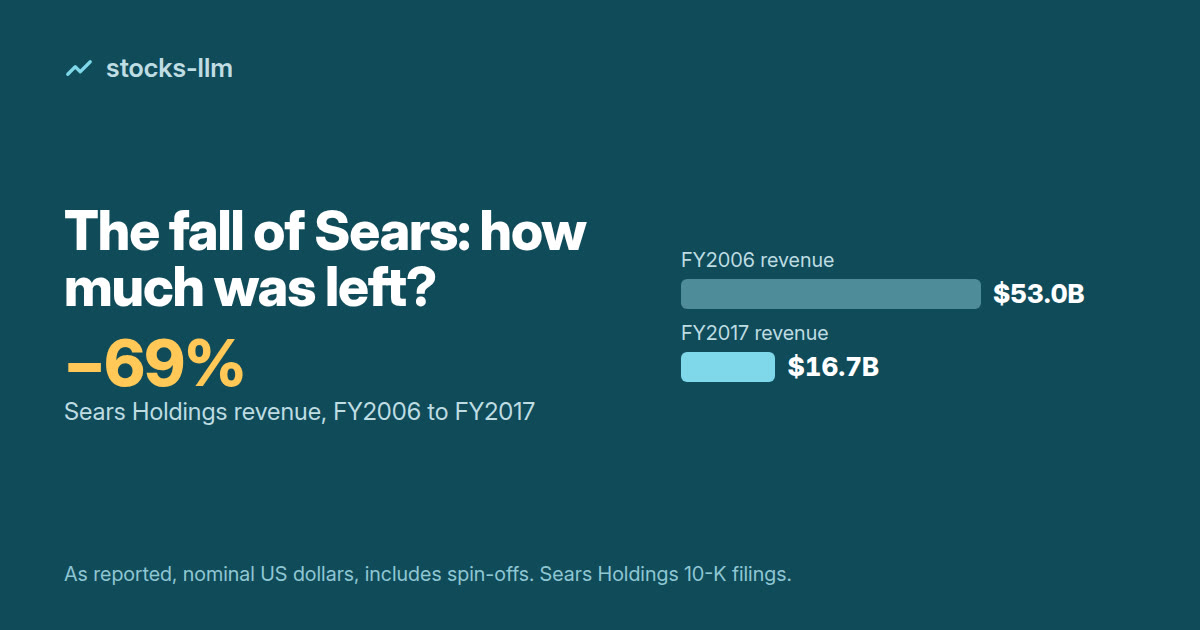
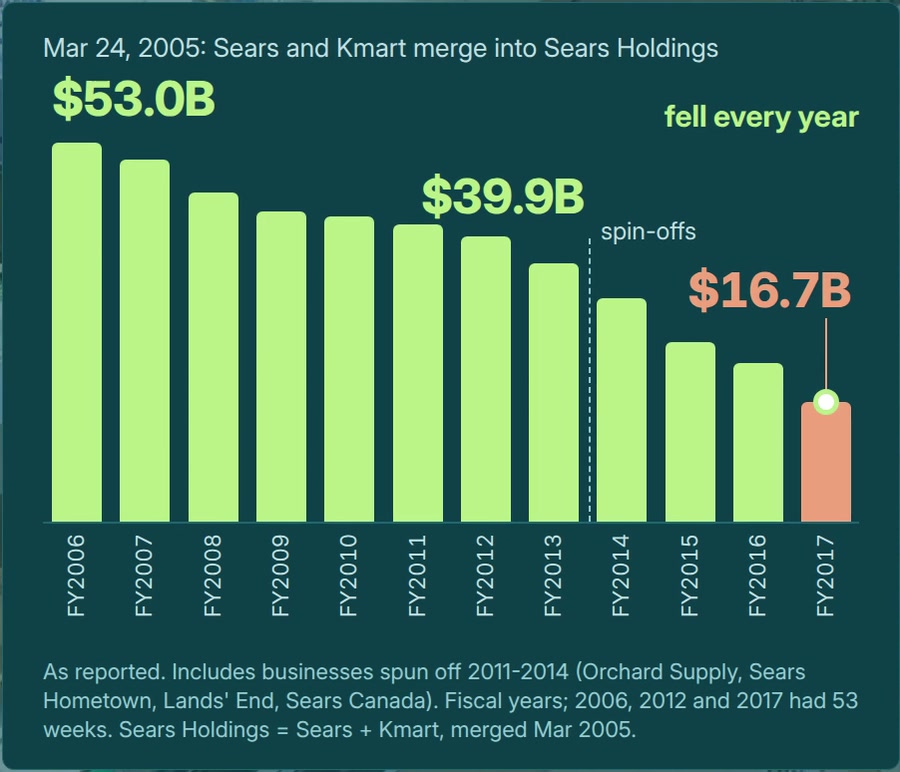
Less than a third. In fiscal 2017, its last full year before it filed for bankruptcy, Sears Holdings reported revenue of $16.7 billion, against $53.0 billion in fiscal 2006, a drop of about 69% as reported (computed).
Sears began as a small catalog house in the 1890s and grew into a retail giant, first through mail order and later through department stores. In January 1993, UPI reported, Sears said it would end its big U.S. catalog by the end of that year, close 113 U.S. stores and cut 50,000 jobs. The catalog's 1992 revenue was estimated at about $3.3 billion. That announcement came 25 years before the bankruptcy filing. On March 24, 2005, Sears and Kmart completed a merger that formed Sears Holdings, so every figure from that point on describes the combined company, Kmart included.
The revenue figures come from Sears Holdings' annual 10-K filings and are in nominal US dollars, as reported. Fiscal years end around January 31 of the following calendar year, and fiscal 2006, 2012 and 2017 each had 53 weeks. Revenue came in below the year before in every one of the 11 years from fiscal 2007 to fiscal 2017. Midway through, in fiscal 2012, it stood at $39.9 billion.
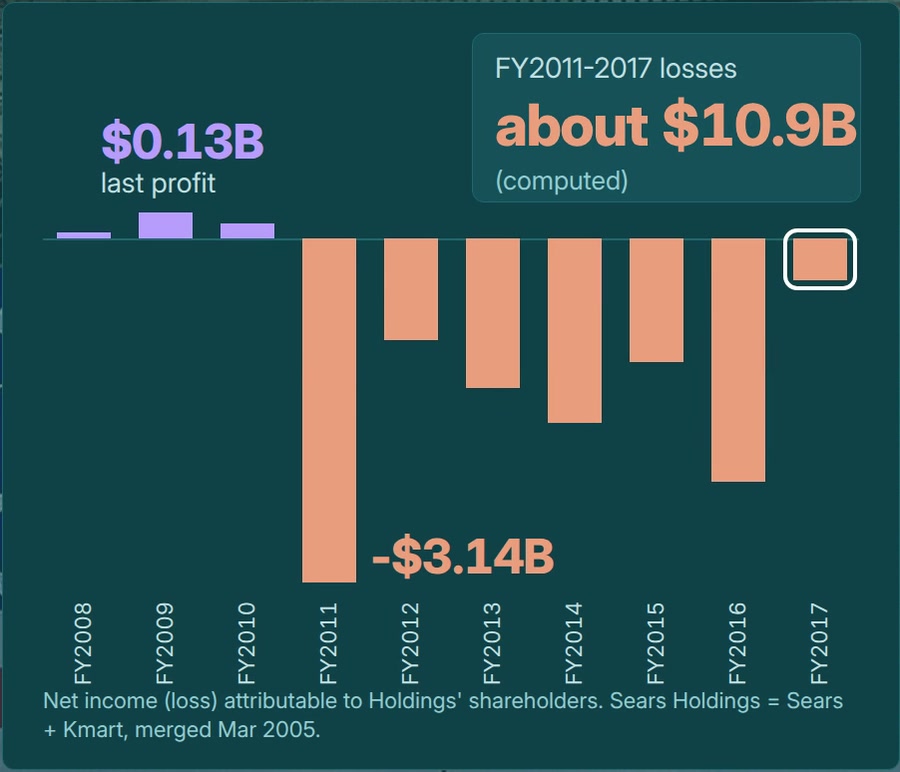
Net income here means net income (loss) attributable to Sears Holdings' shareholders, as filed with the SEC. Fiscal 2010, with $133 million, was the last profitable year. The seven years from fiscal 2011 to fiscal 2017 lost about $10.9 billion in total, a computed sum of the reported annual figures. The largest single annual loss in that run was $3.14 billion, in fiscal 2011.
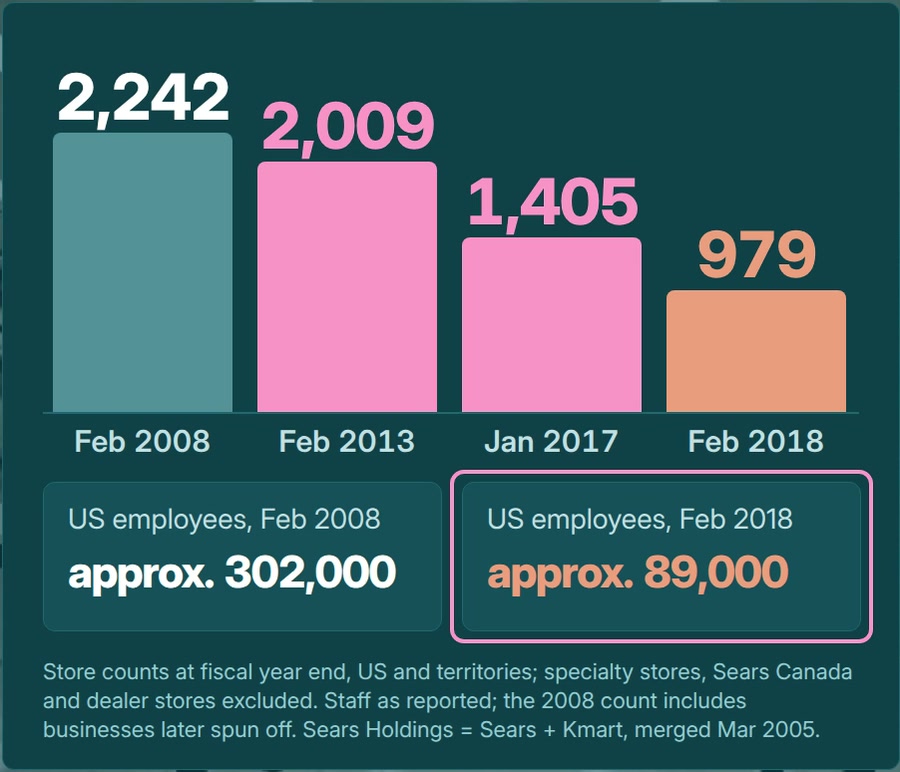
Store counts are taken at fiscal year end and cover Kmart stores plus Sears full-line stores in the US and its territories, leaving out specialty stores, Sears Canada and dealer stores. On that basis the company ran 2,242 stores in February 2008, 2,009 in February 2013, 1,405 in January 2017 and 979 in February 2018. Its U.S. workforce, part-time staff included, went from about 302,000 to about 89,000 over the same ten years.
A quick reading treats the 69% as shoppers walking away in the same proportion. The filings support a narrower statement. The revenue series is as reported, and it contains separations: Sears Holdings spun off Orchard Supply in 2011, Sears Hometown and Outlet in 2012 and Lands' End in 2014, and deconsolidated Sears Canada in 2014. Part of the decline is therefore businesses leaving the company's books rather than a measure of store sales, and the 2008 staff count also includes people at businesses later spun off. What the checked figures do show is revenue lower in every single year of the series.
On October 15, 2018, Sears Holdings filed for Chapter 11 bankruptcy in the US Bankruptcy Court for the Southern District of New York, and its stores stayed open. By November 3, 2018, it had 766 US stores of all kinds, full-line and specialty, a wider basis than the store trend above. The company's quarterly report said an additional 241 stores were set to close in the fourth quarter of 2018. On February 11, 2019, an affiliate of ESL Investments completed its purchase of substantially all of the remaining retail business.
A revenue line can shrink for two reasons that look the same on a chart: sales a retailer no longer makes, and businesses it moves off its books. Reading the basis behind each figure, as reported or restated and which stores are counted, keeps the two apart.
Watch the short video: YouTube
Sources
- Sears Holdings 10-K, fiscal 2007 (filed Mar 26, 2008)
- Sears Holdings 10-K, fiscal 2012 (filed Mar 20, 2013)
- Sears Holdings 10-K, fiscal 2016 (filed Mar 21, 2017)
- Sears Holdings 10-K, fiscal 2017 (filed Mar 23, 2018)
- Sears Holdings 8-K and press release, Oct 15, 2018
- Sears Holdings 10-Q, Q3 2018 (filed Dec 13, 2018)
- Sears Holdings 8-K (filed Feb 14, 2019)
- UPI, Jan 25, 1993