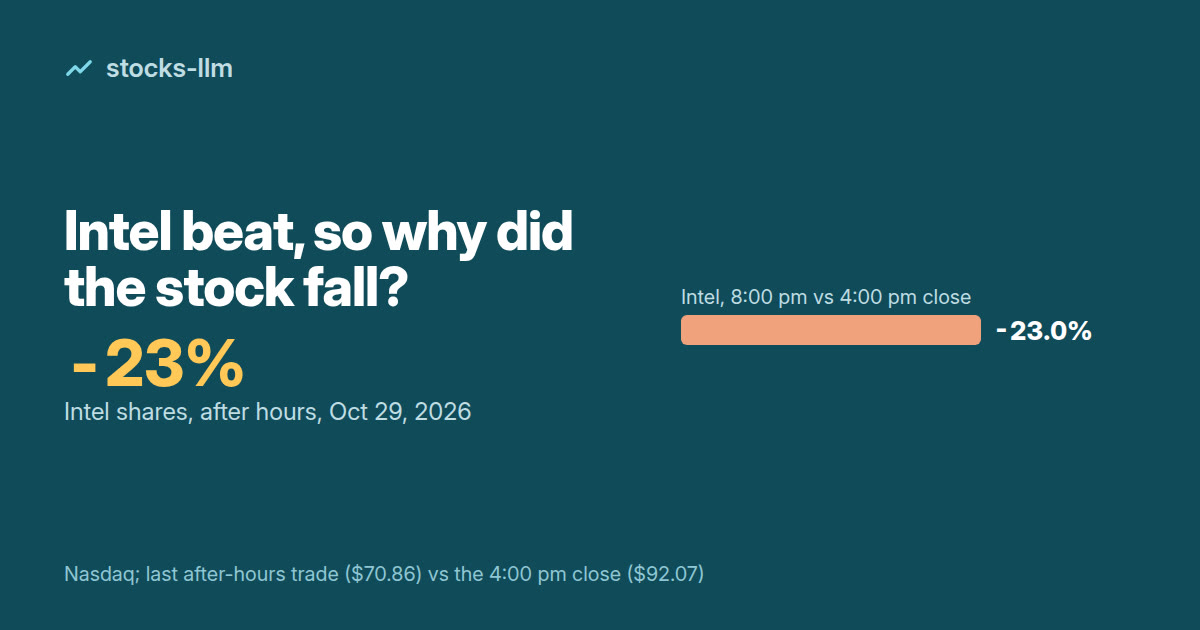
Intel beat Q3 2026 expectations, so why did the stock fall 23%?
Intel's third quarter of 2026 beat expectations: adjusted earnings came in at 52 cents a share, against the 40 cents analysts expected (LSEG, as reported by Reuters). The shares still fell about 23% in after-hours trading on October 29, 2026, and Reuters tied the drop to Intel's forecast of $15 billion to $16 billion in fourth-quarter revenue, against about $17.07 billion analysts expected.
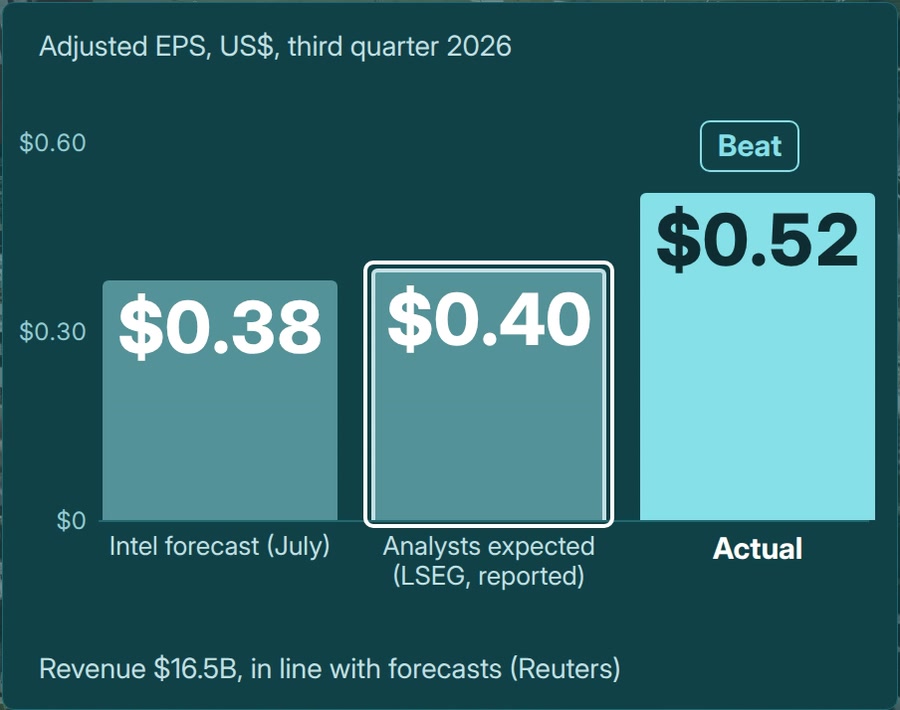
Intel reported results for the quarter ended September 26, 2026, on October 29, shortly after the regular session closed. An earnings release carries two things at once: the quarter that just ended and the company's forecast for the next one. In July, Intel had guided to adjusted earnings of 38 cents a share on revenue of $15.8 billion to $16.8 billion for the third quarter. That July forecast and the analyst consensus were the two yardsticks the new figures were measured against.
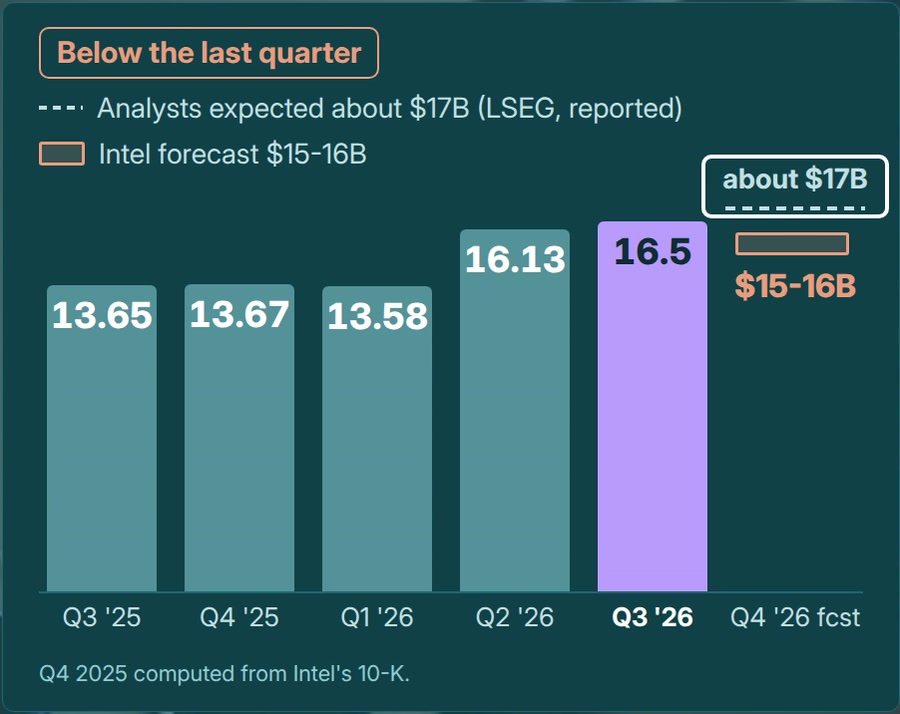
Revenue came in at $16.5 billion, up 21% from $13.7 billion a year earlier, and Reuters described it as roughly in line with the $16.50 billion analysts expected. Every per-share figure here is non-GAAP, which Intel labels adjusted, a basis it reports alongside its GAAP results. On that basis, 52 cents compares with Intel's own July forecast of 38 cents and the 40 cents analysts expected, so the quarter cleared both bars.
The forecast is where the comparison turns. For the fourth quarter of 2026, Intel expects revenue of $15.0 billion to $16.0 billion, so even the top of the range sits below the $16.5 billion it just reported. Analysts expected $17.07 billion. Intel also forecast adjusted earnings of 25 cents a share for the fourth quarter, against the 43 cents analysts expected. The share move compares the last after-hours trade, $70.86 at 8:00 pm ET, with the 4:00 pm close of $92.07 (Nasdaq data), a computed decline of about 23%.
A common reading of a fall like this is that the quarter itself went badly. The checked figures do not support that: earnings beat both yardsticks and revenue was in line. What the quarter does show is a split between Intel's two largest businesses. Data center chip revenue (the DCAI segment) rose to $7.3 billion from $6.3 billion in the second quarter, while PC chip revenue (the CCPG segment) fell to $8.1 billion from $8.9 billion. From a year earlier, Intel reports data center revenue up 78% and PC chip revenue down 5%.
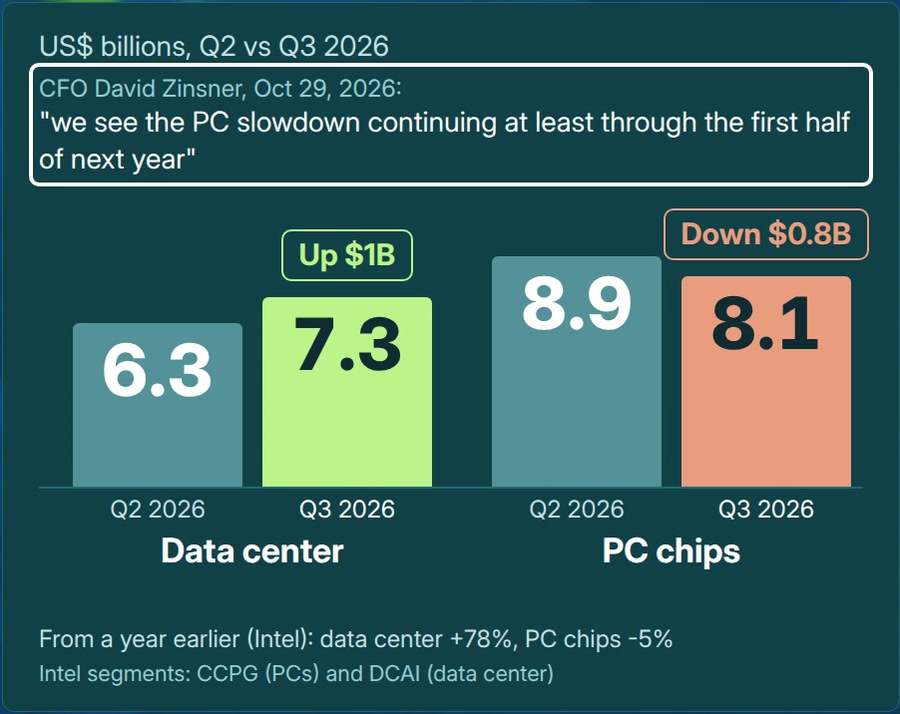
Intel gave its own reasons for the softer outlook. CFO David Zinsner said in the October 29 release: "Looking ahead, we see the PC slowdown continuing at least through the first half of next year". On the earnings call, Intel said an accident in October shut its factory in Israel for about two weeks, and that its guidance includes roughly $300 million less fourth-quarter revenue as a result. That is part of the gap, about $0.3 billion of the $1.57 billion between the midpoint of Intel's range and the analyst estimate, a computed figure. As of the after-hours session on October 29, 2026, that is where the figures stand.
Share prices move on what changes the expected path of a business, not only on the quarter just reported. Here a quarter that cleared its bars came with a forecast below both the last quarter and the analyst estimate, and Reuters tied the drop to that guidance.
Watch the short video: YouTube