Keytruda Is Almost Half of Merck's Sales. What Happens After 2028?
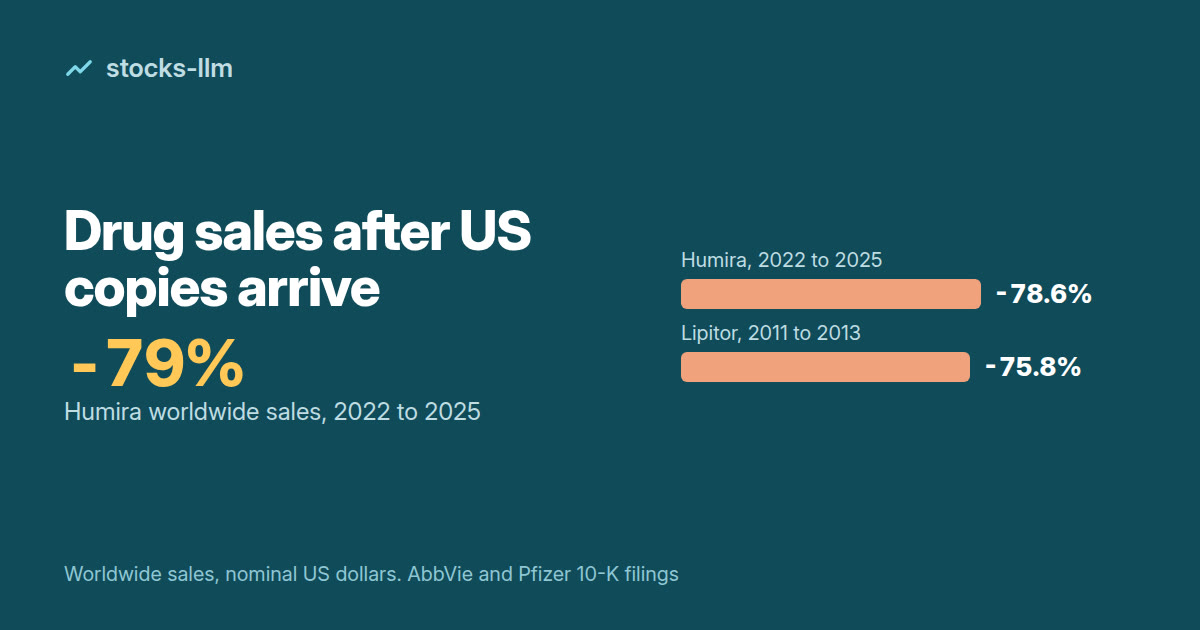
When a blockbuster drug loses its main patent and cheaper copies arrive, its sales have fallen fast: AbbVie's Humira lost 79% of its worldwide sales from 2022 to 2025 after US biosimilars arrived, and Pfizer's Lipitor lost 76% from 2011 to 2013. That history matters for Merck, because Keytruda made almost half of Merck's sales in 2025, 49%, and its main US patent expires in December 2028.
Keytruda is Merck's cancer drug. In Merck's filings it is reported as one combined line, Keytruda/Keytruda Qlex, which includes the newer under-the-skin version. That line sold $25.0 billion in 2023, $29.5 billion in 2024 and $31.7 billion in 2025, up 7% in the last year. Merck's total sales in 2025 were $65.0 billion, and its 10-K for 2025 states that Keytruda represented 49% of them. The drug is still growing: in the third quarter of 2026 it sold $8.6 billion of Merck's $18.1 billion in sales, up 6%, as reported on October 29, 2026.
The patent clock comes from the same 10-K. Merck says biosimilar competition could begin in December 2028, when the primary compound patent expires. Two more patents in the same family run to May and November 2029, and Merck expects litigation over them. In Europe, Merck expects to lose exclusivity in 2031. Merck also expects Keytruda to be selected in 2027 for US Medicare price setting effective January 1, 2029. The under-the-skin Keytruda Qlex has a US key patent to 2043.
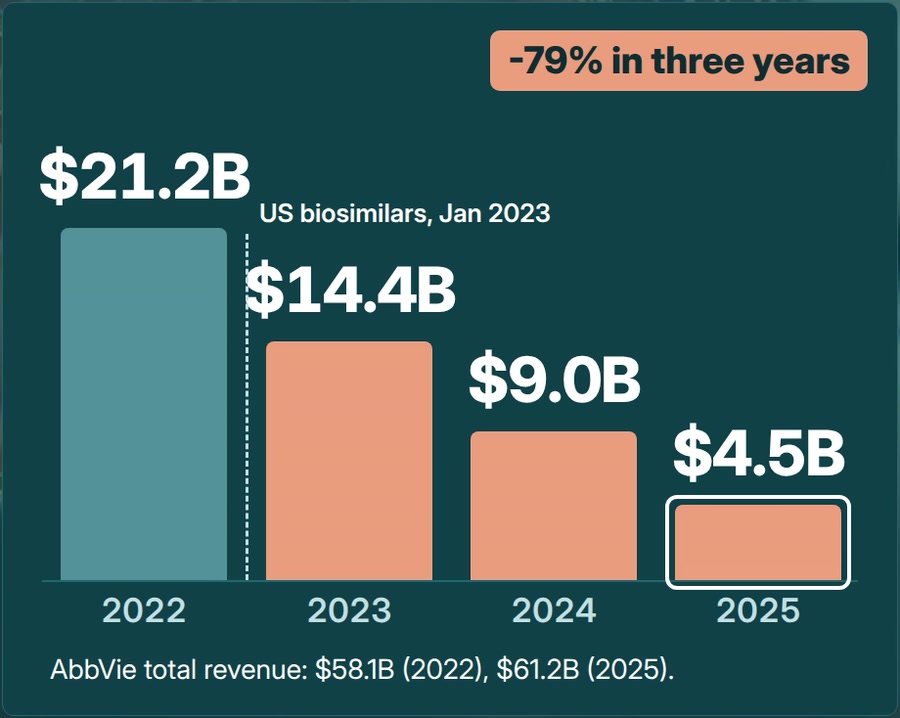
Humira is the closest recent precedent. AbbVie's 10-K filings report its worldwide net revenues at $21.2 billion in 2022, $14.4 billion in 2023, $9.0 billion in 2024 and $4.5 billion in 2025, in nominal US dollars. US biosimilars arrived on January 31, 2023, and the 2022 figure already included years of biosimilar competition in Europe. The 79% fall is computed from those two endpoints. Over the same years AbbVie's total revenue rose from $58.1 billion to $61.2 billion, and its 10-K says Skyrizi and Rinvoq were about 42% of 2025 revenue.
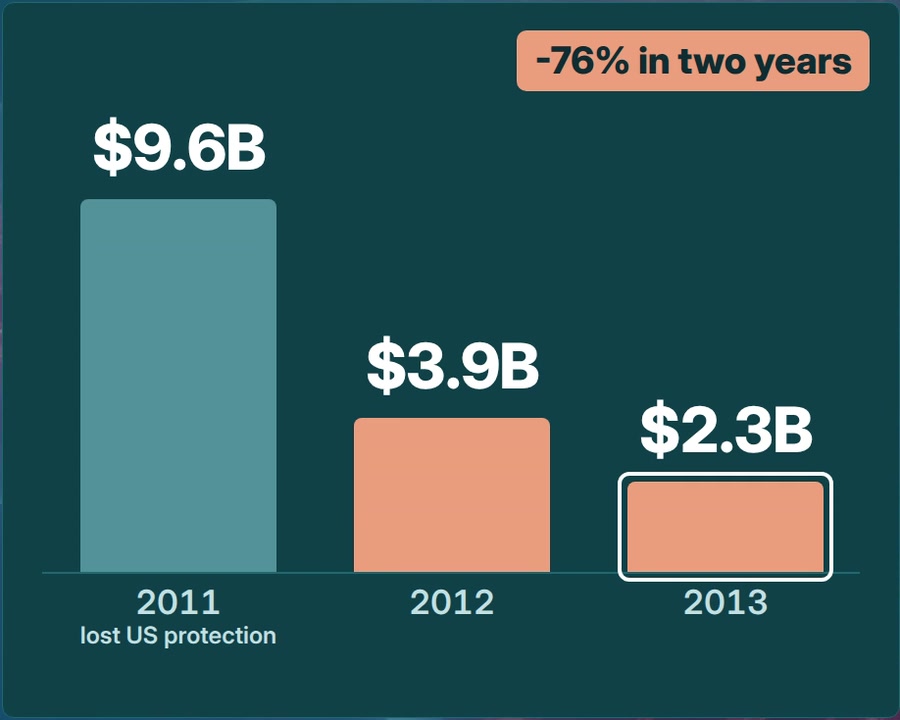
Lipitor is the older case. Pfizer's 10-K for 2013 reports Lipitor revenues of $9.6 billion in 2011, $3.9 billion in 2012 and $2.3 billion in 2013, and says Pfizer lost exclusivity for Lipitor in the US in November 2011. The 76% fall is computed from 2011, the year it lost US protection, to 2013. The two drugs belong to different decades, so their dollar figures are shown on separate charts and compared only as percentage changes.
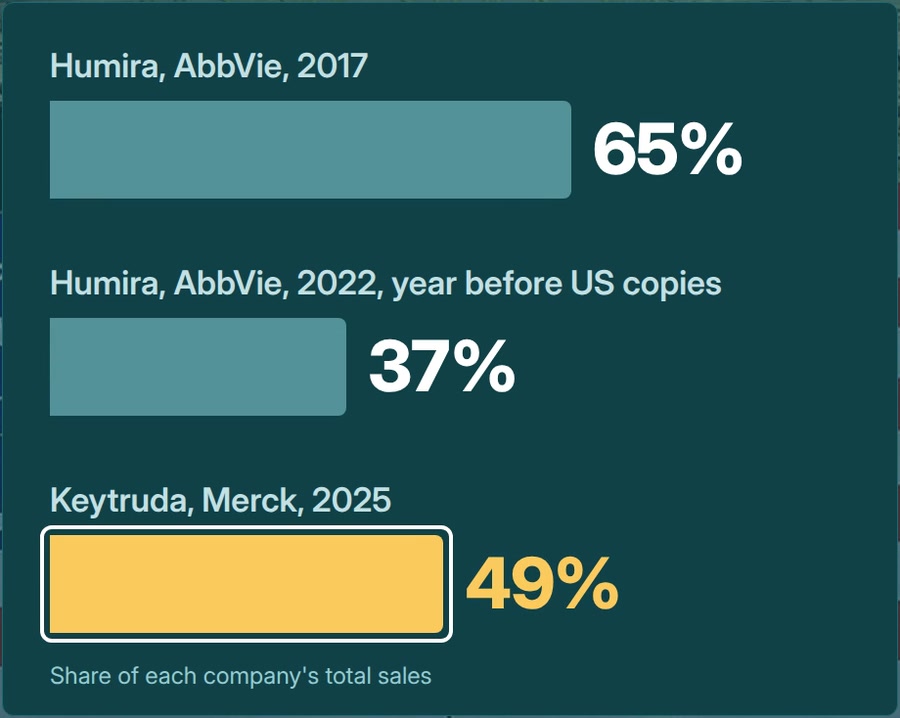
A common reading is that Keytruda now carries a bigger share of its company than Humira ever did. The filings do not support that. AbbVie's 10-K for 2018 says Humira was about 65% of AbbVie's total net revenues in 2017. By 2022, the year before US copies, it was 37%. Keytruda was 49% of Merck's sales in 2025, higher than Humira's 2022 share but below its 2017 share. The Humira and Lipitor declines describe what happened to those two drugs; they are not a forecast for Keytruda.
For Keytruda's future, the only statement on record here is Merck's own. Its 10-K says the company expects that sales of Keytruda will be materially negatively impacted by biosimilar competition between 2028 and 2029. As of October 29, 2026, the drug is still growing, and the 49% share comes from 2025; Merck's next annual report will replace it.
A patent keeps lower priced copies out of a market, so a single drug can carry a large part of a company's sales until the protection ends. The share of sales one product represents shows how much of the total is exposed when copies are allowed in.
Watch the short video: YouTube