Nokia and BlackBerry: from 59% of smartphones in 2007 to today
In 2007, Nokia and Research In Motion, the maker of BlackBerry, together sold almost six of every ten smartphones in the world: 59%, computed from Gartner's figures of 49.4% and 9.6%. Today their sales come from other businesses: Nokia reported EUR 19.9 billion in 2025 from networks and patents, not from selling phones, and BlackBerry reported $549.1 million in fiscal 2026, mostly from software.
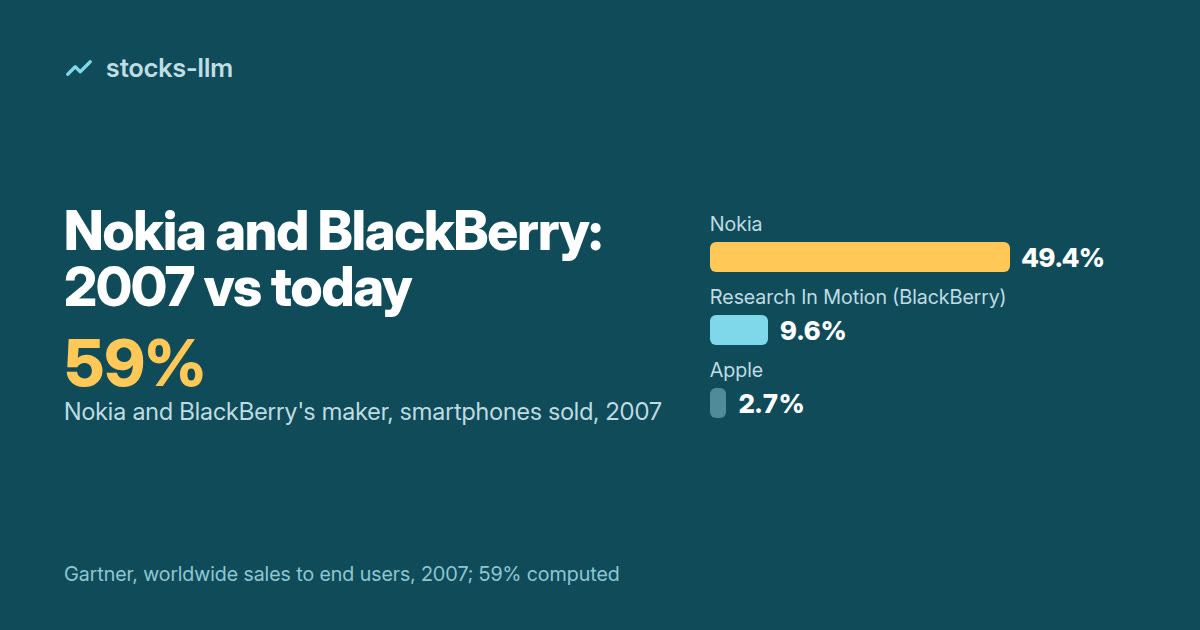
The starting point is Gartner's count of smartphones sold to end users worldwide. For 2007, the year the first iPhone went on sale, Gartner counted about 122.3 million of them. Nokia sold 49.4%, Research In Motion 9.6%, Sharp 5.6%, HTC 3.0% and Apple 2.7%, with 29.6% spread across all other makers. No Android phone was on sale yet: Gartner names the T-Mobile G1, in late 2008, as the first product based on Android.
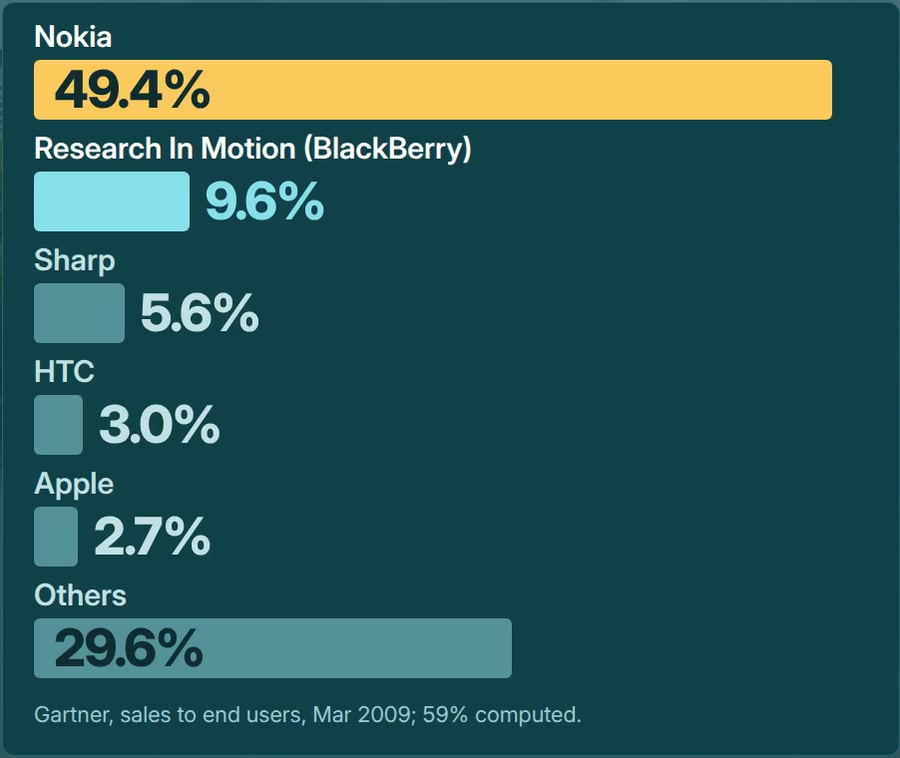
Gartner also splits the same sales by operating system, which tells a different story from the maker table. Symbian, the main system on Nokia's smartphones, had 63.5% in 2007, 37.6% in 2010 and under 1% in 2013. Android went from no phones on sale in 2007 to 22.7% in 2010 and 78.4% in 2013. Apple's iOS had 2.7%, then 15.7%, then 15.6%. BlackBerry's own system had 9.6% in 2007, reached 19.9% in 2009, held 16.0% in 2010 and was at 1.9% in 2013. Each year comes from one Gartner release, published in March 2009, February 2011 and February 2014.
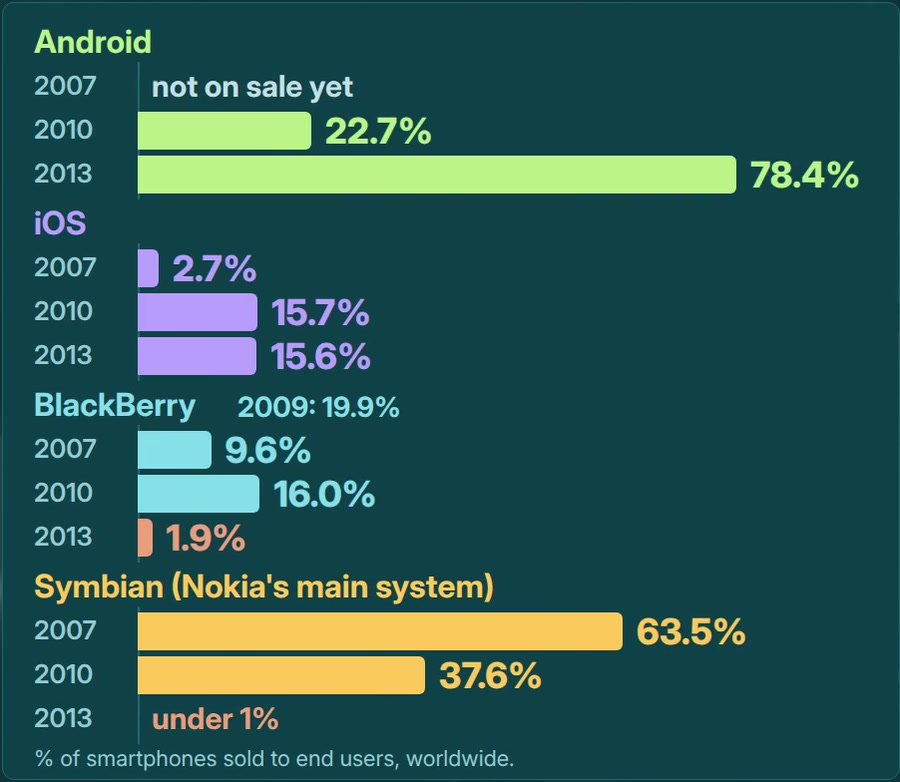
Three common readings of this story do not match the checked figures. The often quoted 63% for Nokia is Symbian's share, an operating system that other makers used too; Nokia's own 2007 share by maker was 49.4%. BlackBerry did not shrink right after the iPhone arrived: its share grew to 19.9% in 2009, and its yearly revenue peaked at $19.9 billion in fiscal 2011, the year to February 2011. And Microsoft did not buy Nokia the company. On September 3, 2013, Microsoft agreed to pay EUR 5.44 billion in cash, EUR 3.79 billion for Nokia's Devices and Services business and EUR 1.65 billion to license its patents. The deal was completed on April 25, 2014, and Nokia kept its networks. That price was a one-off payment, not revenue.
The revenue lines show where each company stands today. Nokia's net sales were EUR 51.1 billion in 2007, a figure that covers phones and, from April 1, 2007, Nokia Siemens Networks; in 2025 they were EUR 19.9 billion from networks and patents. BlackBerry's revenue fell every year for eight years after fiscal 2011 (computed), to $6.8 billion in fiscal 2014 and $1.3 billion in fiscal 2017. On September 28, 2016, it said it would end its own hardware development and rely on partners. In fiscal 2026, the year to February 2026, revenue was $549.1 million, down about 97% from fiscal 2011 (computed). QNX, its software for cars and machines, brought in $268.0 million, Secure Communications $258.9 million and Licensing $22.2 million. The company says QNX runs in more than 275 million vehicles. All money figures are nominal, not adjusted for inflation, and Nokia's euros and BlackBerry's dollars are not comparable to each other.
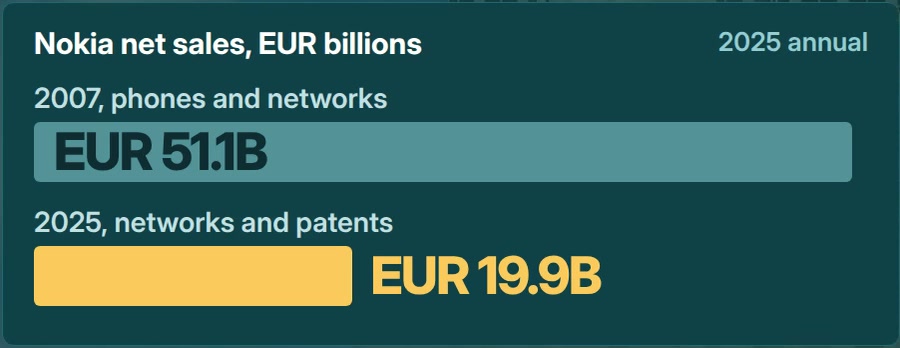
A share chart shows how one year's total sales were split among makers or systems, while a revenue line shows what a single company earned in its own currency and fiscal year. Read together, they describe two companies that left the phone business they led in 2007 and now earn from what they kept: networks and patents for Nokia, software for BlackBerry.
Watch the short video: YouTube
Sources
- Gartner, smartphone sales 2007 and 2008, March 11, 2009 (archived)
- Gartner, smartphone sales 2010 by operating system, February 2011 (archived)
- Gartner, smartphone sales 2013 by operating system, February 13, 2014 (archived)
- Microsoft, deal for Nokia's Devices and Services business, September 3, 2013
- Microsoft, deal completed, April 25, 2014
- Nokia, Q4 and full year 2007 results, Form 6-K, January 24, 2008
- Nokia, Q4 and full year 2025 report, January 29, 2026
- TechCrunch, BlackBerry ends its own hardware development, September 28, 2016
- BlackBerry, fiscal 2026 results, April 9, 2026