Which Listed AI Neocloud Owes the Most? CoreWeave, Nebius and IREN
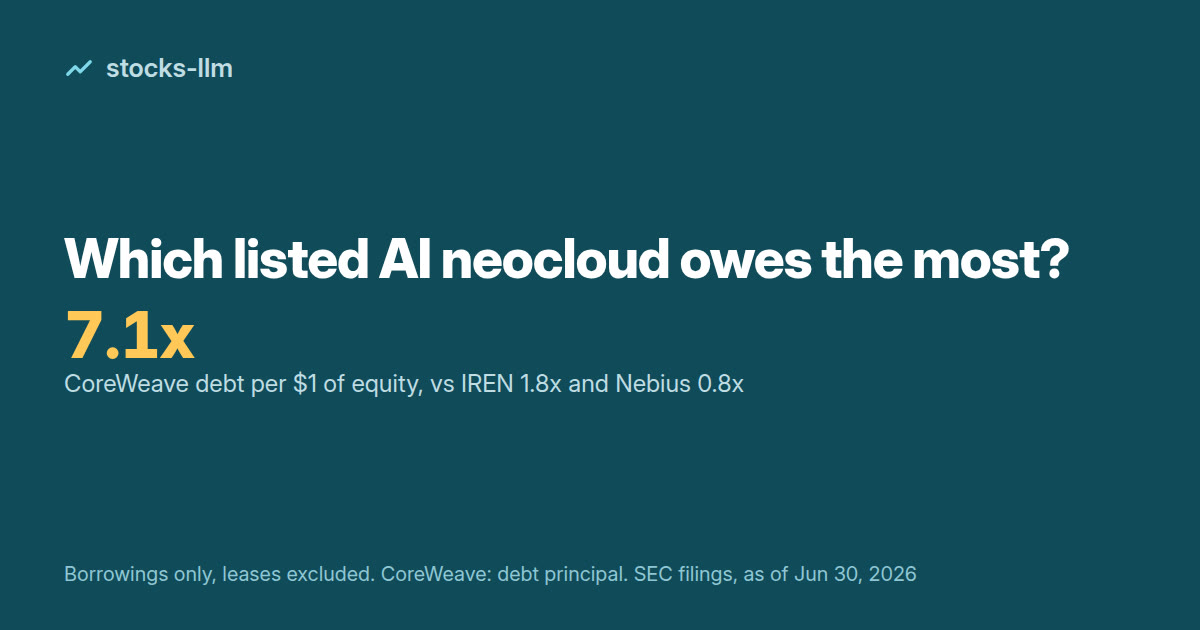
Among US-listed GPU clouds worth over $1 billion and covered on stocks-llm.com, CoreWeave carries the most debt for each dollar of equity: about $7, or 7.1x, as of June 30, 2026. IREN carries about $1.80 per dollar (1.8x) and Nebius less than $1 (0.8x).
Neoclouds are companies that rent out computing power for artificial intelligence. This comparison uses the narrow trade meaning of the word: companies that rent out their own AI chips, often called GPU clouds. Under that rule, three US-listed companies worth over $1 billion remain: CoreWeave, Nebius and IREN. Data-center landlords such as Applied Digital, which lease buildings rather than rent out chips, run a different business and are not part of the comparison, and private companies are left out.
Sales at all three have grown quickly. In each company's latest fiscal year, Nebius revenue rose 479%, from $91.5 million to $529.8 million, CoreWeave revenue rose 168%, from $1.915 billion to $5.131 billion, and IREN revenue rose 41%, from $501.0 million to $707.0 million. The fiscal years differ: calendar 2025 for CoreWeave and Nebius, and the year to June 30, 2026 for IREN. The Nebius comparison uses the restated prior year from its own annual report.
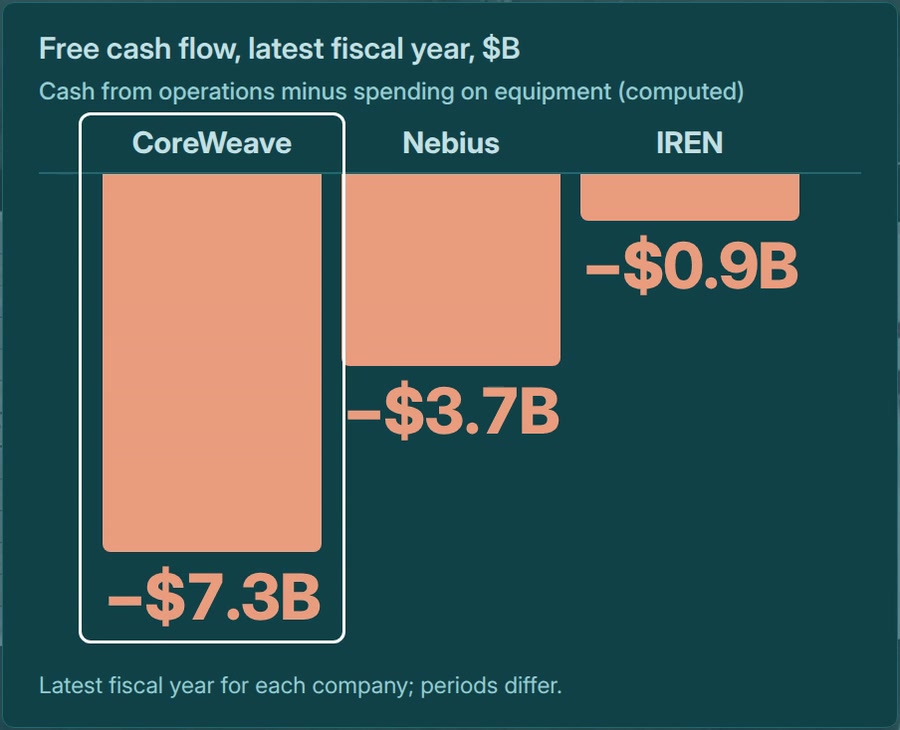
Growth has not come with cash. Free cash flow, computed here as cash from operations minus capital spending, was negative for all three in their latest fiscal year. CoreWeave brought in $3.058 billion from operations and spent $10.309 billion on equipment, a gap of $7.25 billion. The gap was $3.68 billion at Nebius and $0.90 billion at IREN. In each case the company spent more on chips and data centers than its business brought in.
Profits are scarce too, and one figure is easy to misread. CoreWeave reported a net loss of $1.167 billion for 2025 and IREN a net loss of $702.6 million for its fiscal year, so neither has a price-to-earnings ratio. Nebius reported net income of $82.5 million for 2025, or $0.33 per diluted share, which against its $158.74 close on October 23, 2026 gives a P/E of about 480. That ratio does not describe its operations: Nebius had an operating loss of $611.7 million in the same year, so its profit came from items outside its operations.
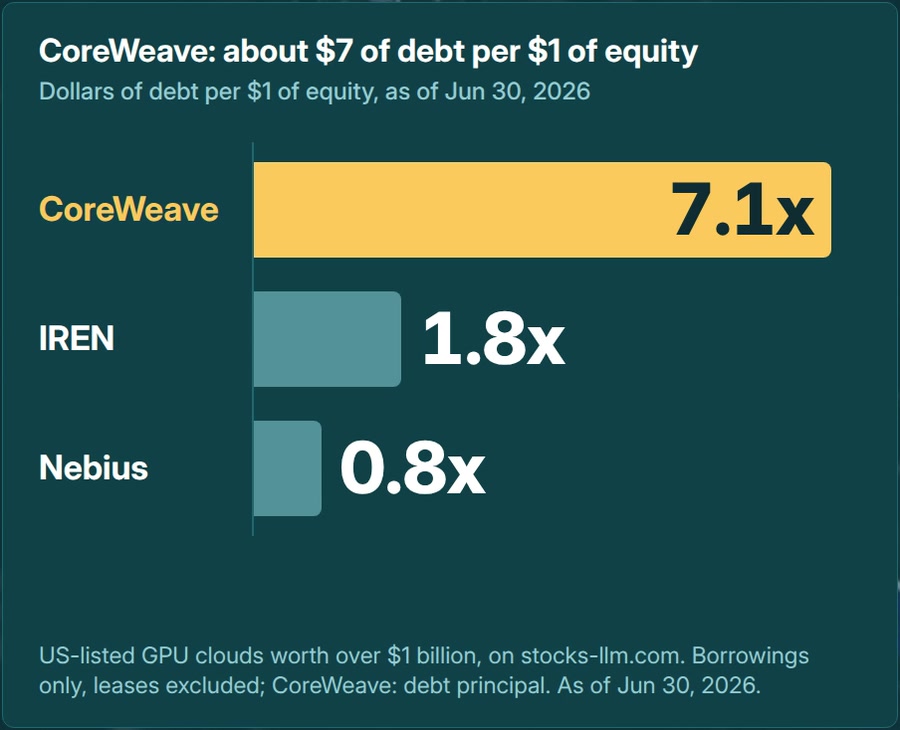
Debt to equity compares what a company owes with what its shareholders own. Here debt means borrowings only, with leases excluded, all taken from the June 30, 2026 balance sheets reported in SEC filings. CoreWeave had $35.6 billion of debt principal against $5.0 billion of equity, which works out to 7.1x. IREN had $7.6 billion of debt against $4.2 billion of equity, or 1.8x, and Nebius had $8.5 billion against $10.3 billion, or 0.8x. In dollars as well as per dollar of equity, CoreWeave owes the most of the three.
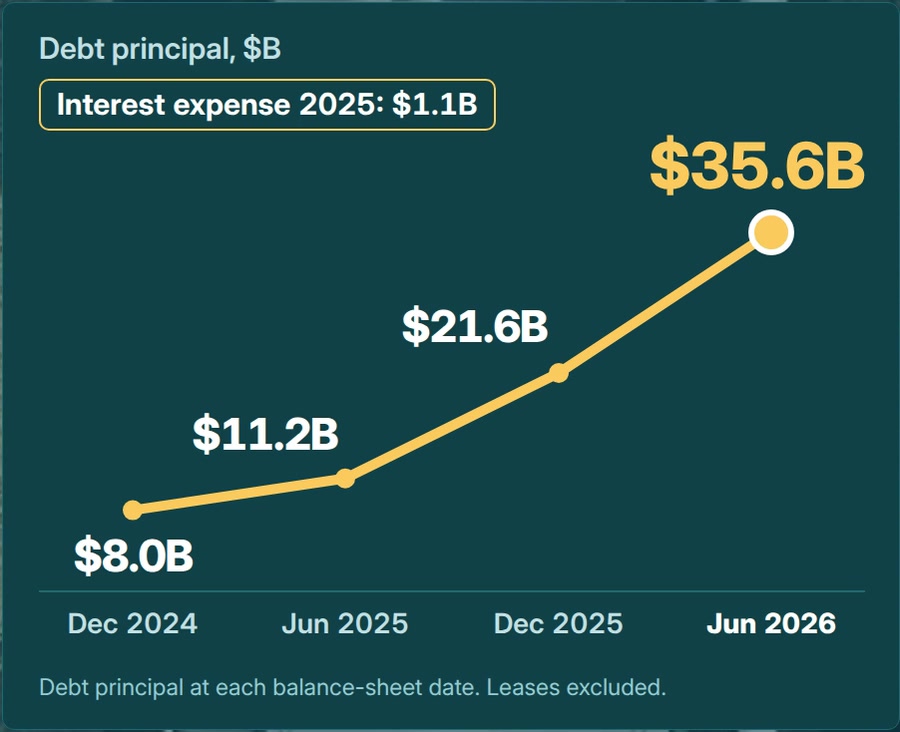
CoreWeave's borrowing has also grown fastest. Its debt principal stood at $8.0 billion at the end of 2024, $11.2 billion in June 2025, $21.6 billion at the end of 2025 and $35.6 billion in June 2026. Its interest expense on that debt was $1.148 billion in 2025 alone. All of these figures come from the latest filings, and the third-quarter reports due in November 2026 will update every ratio in this comparison.
The figures connect through one mechanism. When a company spends more on equipment than its operations bring in, the difference has to be funded, and when borrowing covers most of it, debt grows faster than equity and the ratio of the two rises.
Watch the short video: YouTube