Who pays Palantir: US government vs businesses, and a 59x sales price
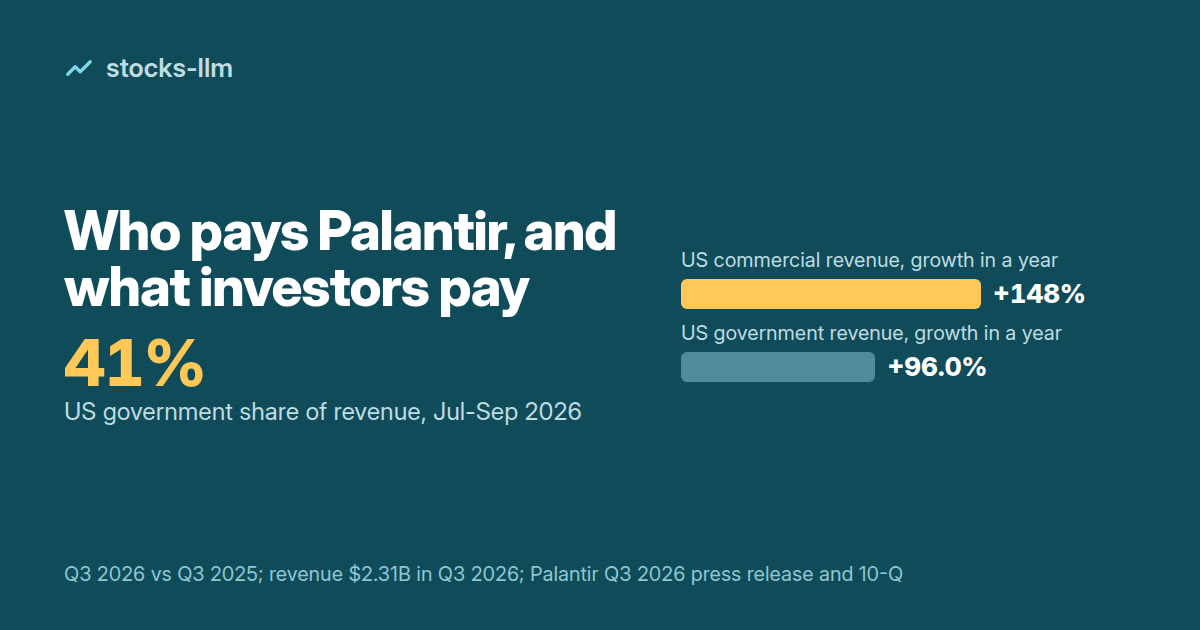
In the third quarter of 2026 (July to September), about 41% of Palantir's revenue came from the US government, and US businesses paid slightly more, about 43%. At the November 2, 2026 close, investors valued Palantir at about 59 times its sales over the past year, compared with about 11 times for Microsoft.
Palantir sells software to two kinds of customers: governments and commercial organizations such as businesses. It is often described simply as a government contractor. Its quarterly results split revenue by customer type and by region, which makes it possible to check how well that label fits today.
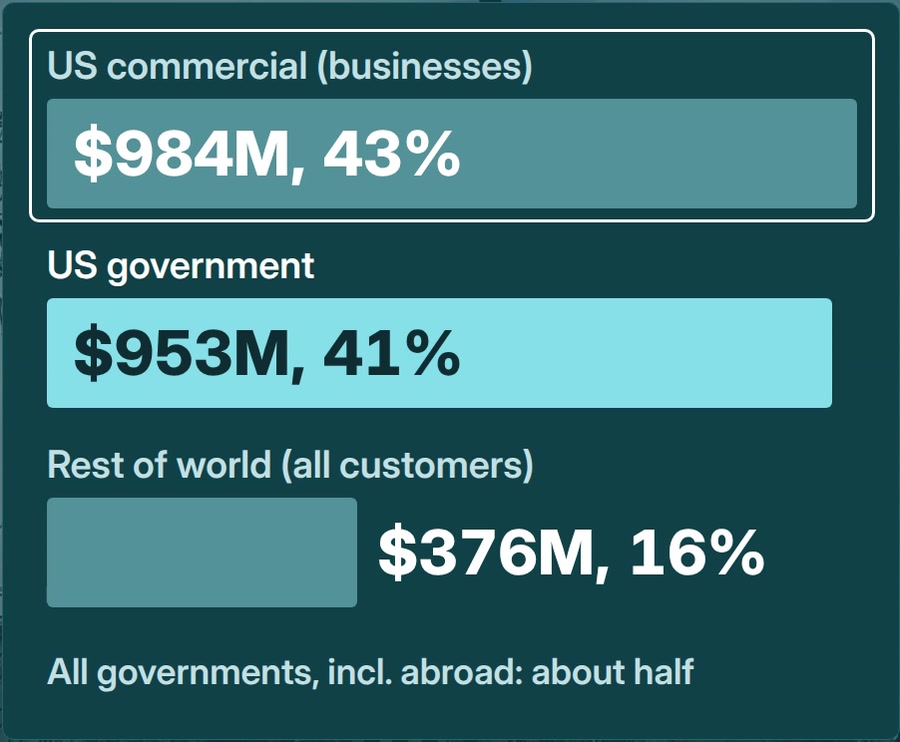
Palantir reported revenue of $2.313 billion for the quarter ended September 30, 2026, up 96% from a year earlier. Its press release breaks out two US lines: US commercial revenue of $984 million and US government revenue of $953 million. The 10-Q adds rest of world revenue of $376.2 million, which mixes government and commercial customers abroad. Dividing each line by the quarter's total gives shares of about 43%, 41% and 16%. These shares describe one quarter only, not the full year.
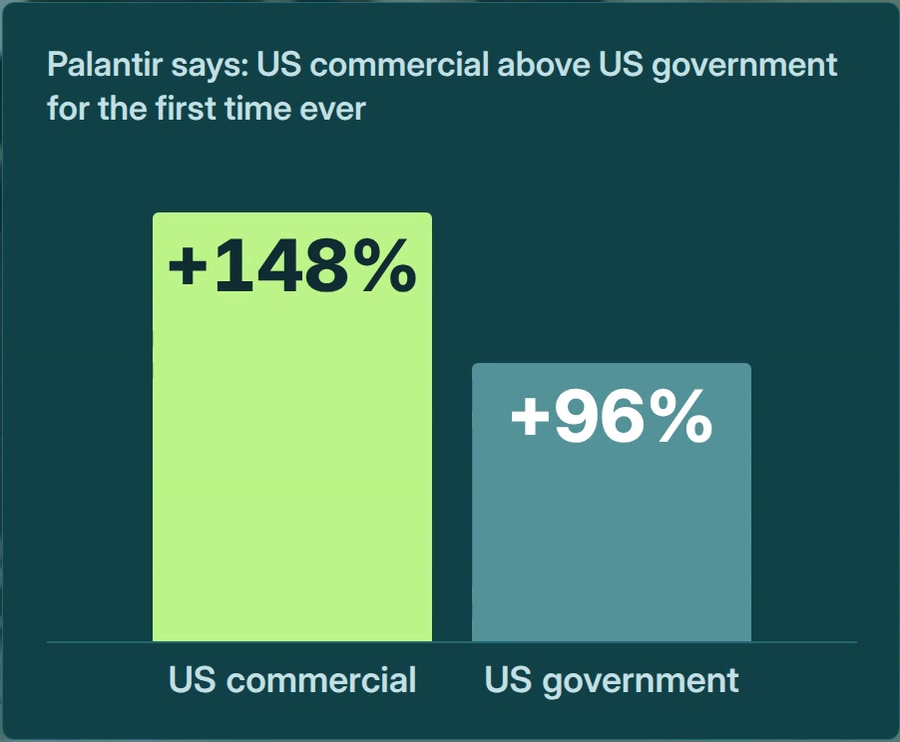
Growth is measured the same way, the third quarter of 2026 against the third quarter of 2025. US commercial revenue grew 148% and US government revenue grew 96%. Palantir says US commercial revenue passed US government revenue for the first time ever. That statement covers the two US lines only. It is Palantir's own comparison, and the company does not split rest of world revenue between governments and businesses.
Calling Palantir just a government contractor is a shortcut, and the checked figures give a more mixed picture. No single part of the quarter's revenue is a majority. If foreign governments are added, through Palantir's worldwide Government segment, governments of all countries account for about half of the quarter's revenue, and the Commercial segment for the other half. So the government label is partly right worldwide, while in the US the commercial line was slightly larger last quarter.
The customer base is also measured in a specific way. Palantir counts a customer as an organization it recognized revenue from in the trailing twelve months. On that basis it had 1,090 customers as of September 30, 2026, up from 911 a year earlier. Dividing revenue over the last twelve months, $7.29 billion, by 1,090 gives about $6.7 million per customer on average (computed). The 10-Q reports that the top 20 customers paid about $146 million each over the same twelve months, so together they made up about 40% of revenue (computed). Palantir does not name them.
The second half of the question is what investors pay. Price-to-sales here is computed as market value at the November 2, 2026 close divided by revenue over each company's last four reported quarters. Palantir was worth about $430 billion, or 58.9 times sales. Five big software companies, our selection, came in lower: Microsoft 10.9 times, ServiceNow 7.1, Oracle 5.0, Salesforce 4.2 and Adobe 3.8. Palantir was valued above Oracle, about $430 billion against about $360 billion, with about a tenth of Oracle's revenue. That close came before Palantir released its third quarter results, so the price does not reflect them.
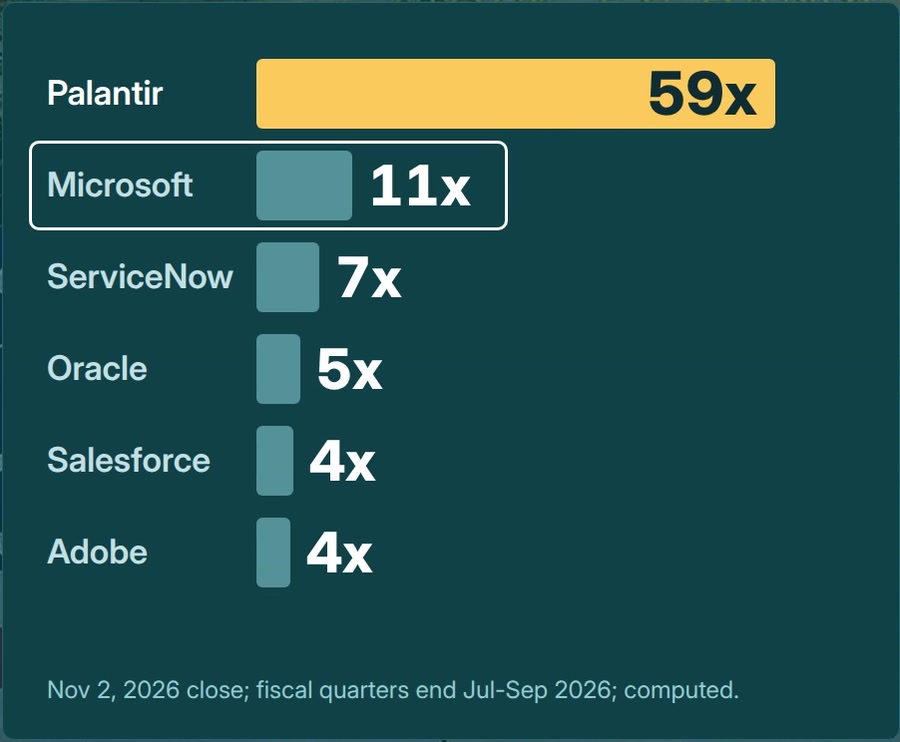
A price-to-sales multiple divides what the market pays on one day by revenue already earned. The higher the multiple, the larger the part of a company's value that rests on revenue it has not yet reported, which is how two companies with very different sales can carry similar price tags.
Watch the short video: YouTube