Why UPS cut its Amazon packages by more than half
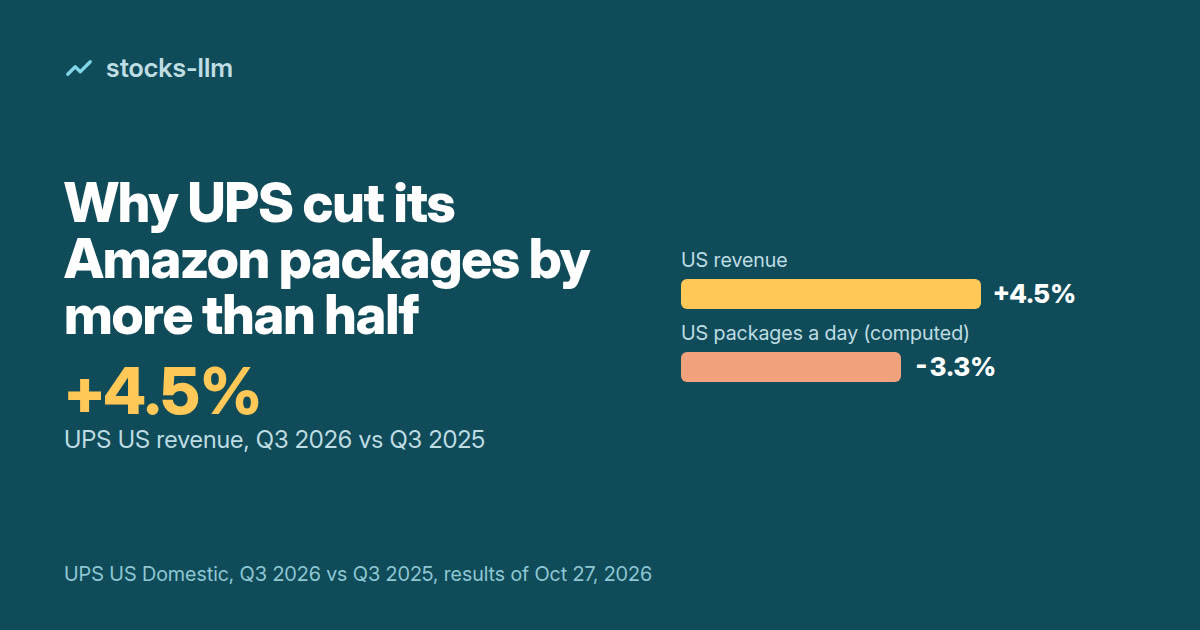
UPS said in January 2025 that it would cut the Amazon volume it delivers by more than 50% from 2024 levels by June 2026, because Amazon, its largest customer, was not its most profitable one. UPS says the cut was completed in the second quarter of 2026, and in the third quarter of 2026 its US revenue rose 4.5% on 3.3% fewer packages a day than a year earlier.
Amazon has long been the biggest single customer of UPS. In its annual report for 2024, UPS said Amazon represented approximately 11.8% of its consolidated revenues, substantially all of it in its US Domestic Package segment. On January 30, 2025, UPS announced an agreement in principle to reduce that customer's volume by more than half. On the earnings call that day, UPS executives said about 20% to 25% of the volume in the UPS US network was tied to Amazon, as reported by Supply Chain Dive. CEO Carol Tomé put the reason this way, as reported: "Amazon is our largest customer, but it's not our most profitable customer." Amazon said that UPS requested the reduction.
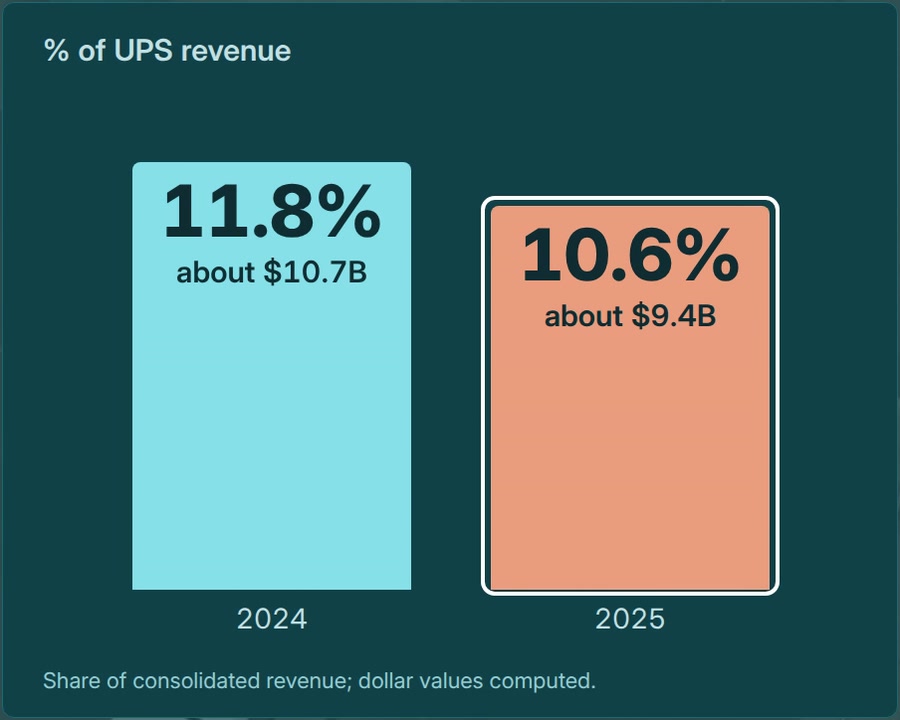
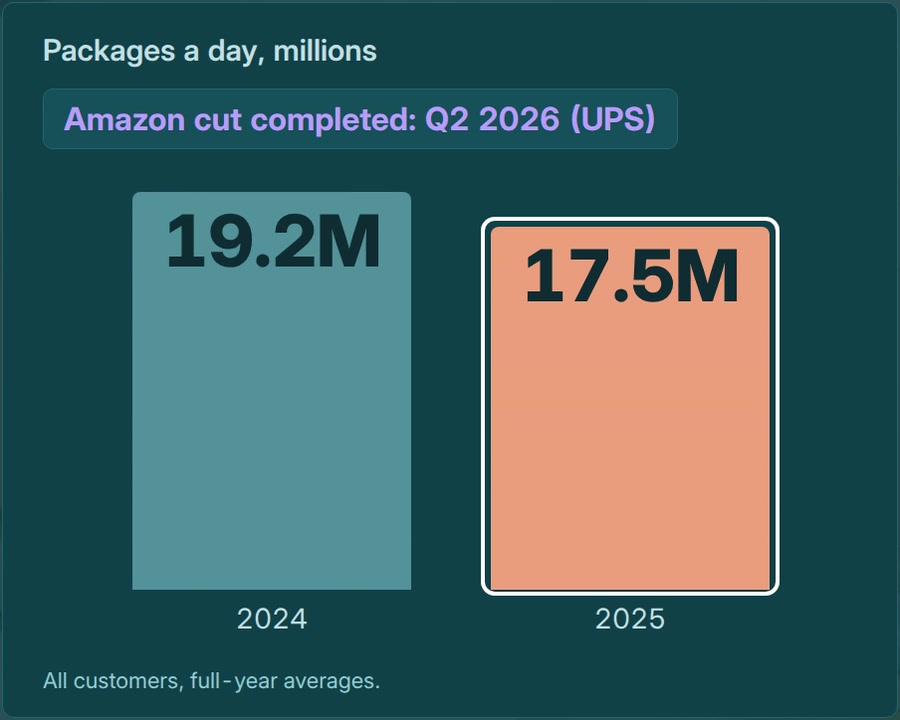
The first figure is Amazon's share of all UPS revenue, not of the US business alone. It fell from 11.8% in 2024 to 10.6% in 2025, according to the two annual reports. The dollar amounts are computed by multiplying each share by UPS consolidated revenue of $91.07 billion and $88.66 billion, which gives about $10.7 billion and about $9.4 billion. The second figure is the average number of packages a day in the UPS US network, for all customers, as full-year averages: 19.2 million in 2024 and 17.5 million in 2025.
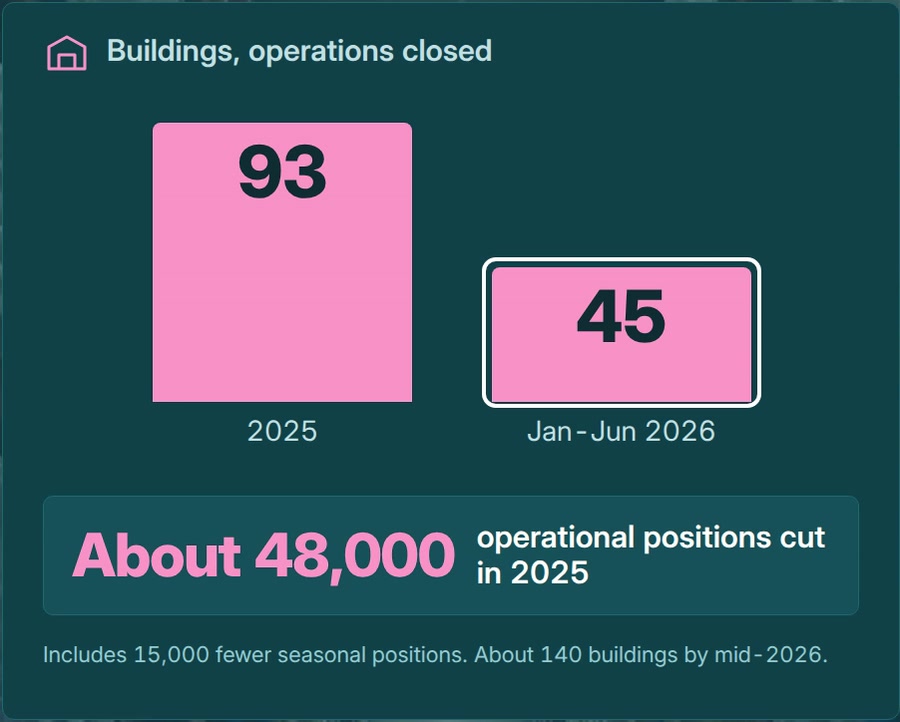
UPS also shrank its network. It closed daily operations at 93 leased and owned buildings during 2025, and closed 45 more in the first six months of 2026, 44 of them permanently. It reduced its operational workforce by about 48,000 positions in 2025, including 15,000 fewer seasonal positions. UPS describes this program as part of its execution of planned volume declines from its largest customer.
A common reading is that Amazon walked away, or that the total UPS package count halved. The checked figures say neither. UPS initiated the cut, and Amazon was still about 10.6% of UPS revenue in 2025. UPS has never published how many Amazon packages it carries, so the more than 50% figure is the company's plan and its own statement, not a measured count. The fall from 19.2 million to 17.5 million packages a day covers every customer, not Amazon alone. UPS has published no price or margin for Amazon's packages either. Meanwhile Amazon runs its own delivery network: Pitney Bowes estimates it carried about 6.9 billion of the 23.1 billion US parcels in 2025, more than any other carrier. Amazon publishes no parcel count, and no source links those parcels to the UPS cut.
As of UPS's third quarter 2026 results, released October 27, 2026, the planned reductions from its largest customer were completed in the second quarter of 2026. In the US network, average daily packages went from 16.15 million in the third quarter of 2025 to 15.62 million a year later, a computed decline of 3.3%. US revenue went from $14.22 billion to $14.87 billion, up 4.5%, which UPS attributed to a 6.1% increase in revenue per piece. UPS has published no building count after June 30, 2026.
A carrier's revenue depends on both how many packages it moves and what each package pays. By letting lower yielding volume go and shrinking its network to match, UPS traded package count for revenue per piece, the shift its filings describe as a focus on higher yielding volume.
Watch the short video: YouTube
Sources
- UPS Form 10-K for 2024, filed February 18, 2025
- UPS Form 10-K for 2025, filed February 17, 2026
- UPS fourth quarter 2025 earnings release, January 27, 2026
- UPS Form 10-Q for Q2 2026, filed August 5, 2026
- UPS third quarter 2026 earnings release, October 27, 2026
- Supply Chain Dive, January 30, 2025
- Pitney Bowes Parcel Shipping Index, 2026 report